Smashing Down the Middle in Badminton Doubles: Attacking the Centre & Who Takes the Shuttle
7 June 2026 · Badminton Fans
**A doubles smash down the middle works because it creates a "whose shuttle is it?" moment between the two defenders — both can reach it, neither has a clear claim, and the half-second of hesitation produces either no return at all or a weak, late one. Combined with a pre-agreed convention on your side for who takes the middle, the middle smash is one of the highest-percentage attacks in the game.** When in doubt, hit it down the middle.
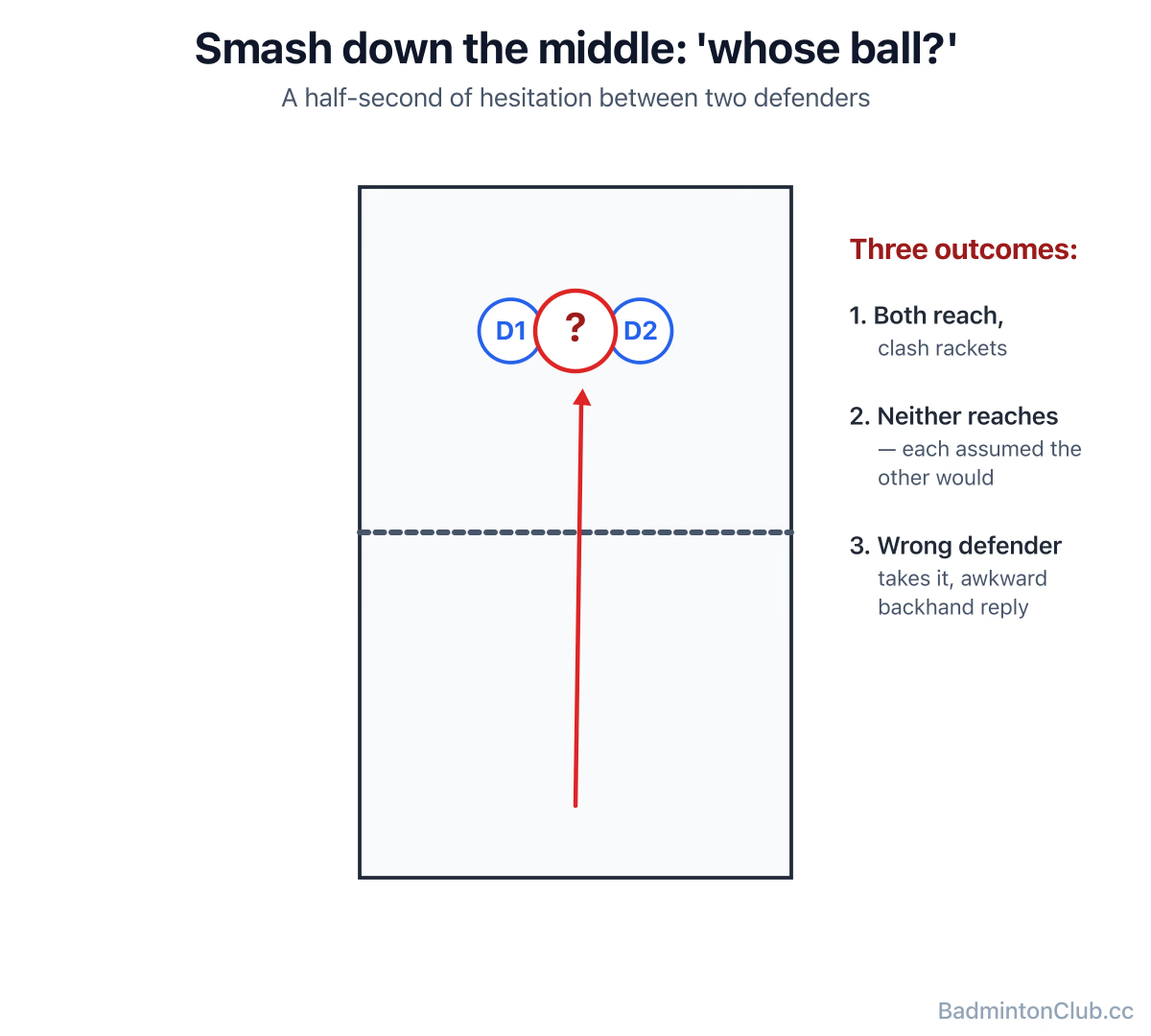
Why the middle works
A smash to a corner has one obvious defender, and they're already set up to take it. A smash to the middle has two defenders who can both reach it — but neither has a decisive claim. In the half-second it takes them to communicate (or not), three things can happen:
- Both reach — they clash rackets, or both pull off mid-swing, producing a weak or no return.
- Neither reaches — each assuming the other will. Free point.
- The "wrong" one takes it — the partner whose body angle was worse, producing an awkward backhand or stretched defence.
Even at higher level, where pairs have grooved their middle conventions, a flat middle smash with disguise produces a measurably weaker reply than a corner smash to a settled defender. At club level it sometimes produces no return at all.
How to attack the middle effectively
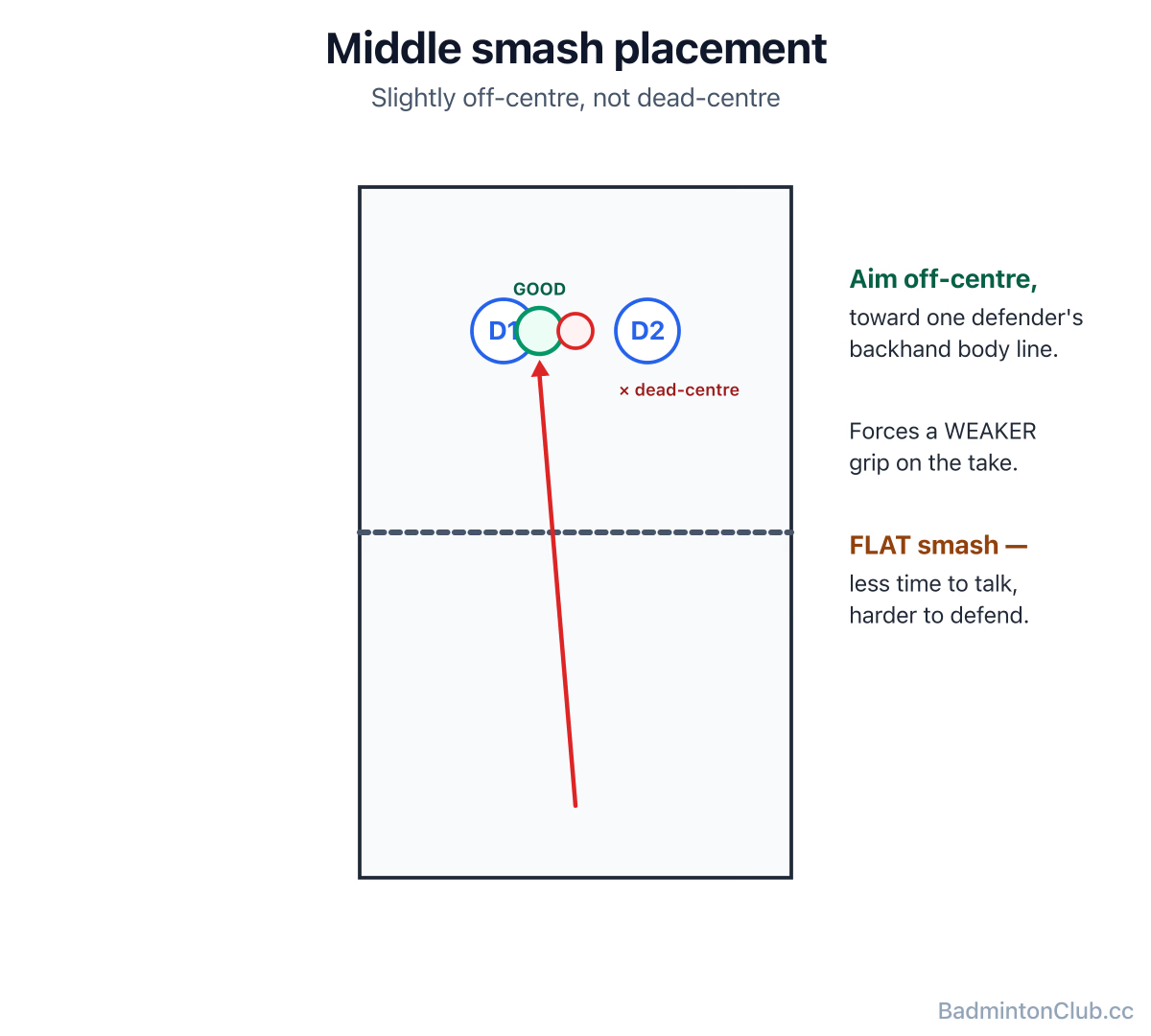
- Aim slightly off centre, toward one defender's body line — not dead-centre, which both can deal with cleanly, but a few inches into the player whose backhand it would catch. Forces them to take it with the weaker grip.
- Use flat smashes — a flatter trajectory arrives faster and gives less time to communicate. Steep smashes to the middle are easier to defend cleanly.
- Mix with corner smashes — once the defenders are leaning to cover the corners, the middle opens up. A few corner smashes set up the middle smash that wins the point.
- In mixed, aim at the woman's body line down the middle — combines the middle confusion with the "attack the woman" idea covered in Mixed Doubles Tactics.
Who takes the middle on your side
The flip side: when the opposition smashes down your middle, who takes it? It's the classic doubles question, and the answer is a convention you agree beforehand — not a mid-rally debate.
- Default #1 (forehand side). The partner whose forehand is in the middle takes it. Two right-handers v two right-handers: the player on the left of the court (their forehand reaches into the middle) takes middle shots by default.
- Default #2 (whoever isn't already committed). If one partner is mid-stroke or out of position, the other takes the middle regardless of side. Overrides #1 in real play.
- Default #3 (the back player on lifts). When the middle shuttle comes from a lift back toward your rear court, the back-court player takes it. The front player takes the middle on flat exchanges.
Talk about it before the match. "Yours" and "mine" calls during rallies are good; better is agreed defaults so the calls aren't needed. The team page on BadmintonClub.cc is the obvious place to write the convention down once with your regular partner so you're not relitigating it every league night.
What coaches actually shout from the side
"DOWN THE MIDDLE!" and "WHOSE IS THAT?!" — almost certainly the two most-shouted phrases at club doubles. A frank opinion: many pairs under-use the middle attack because corner shots feel more skill-showing, but the middle is statistically the higher-percentage point at most levels. And many pairs gift middle points because they never agreed who takes them. Spend five minutes before your next league match talking the convention and your defence improves overnight. Spend ten minutes deliberately drilling middle smashes with disguise and so does your attack. None of this needs equipment beyond the racket in your hand and the shuttles in your bag — though if you also use the smashes covered in Smash Variations and a flat trajectory, the middle smash plays better still.
FAQ
- Q: Why do badminton players smash down the middle in doubles? It creates "whose shuttle is it?" confusion between the two defenders — the half-second of hesitation produces a clash, no return, or a weak, late one.
- Q: Where exactly should a middle smash aim? Slightly off-centre toward one defender's backhand body line — not dead-centre — using a flatter, faster trajectory.
- Q: Who should take the middle shuttle in doubles? Agree a convention beforehand — typically the partner with the forehand in the middle takes it by default, overridden by whoever isn't already committed elsewhere.
- Q: Is the middle smash high-percentage? Yes — at most levels it's one of the highest-return attacks in doubles, especially mixed with the occasional corner smash to set defenders leaning outward.
- Q: How do you defend a middle smash? Communicate (a quick "mine!"), use your pre-agreed convention, and bias your racket toward the middle when defending side-by-side so the take is fast.
- Q: Is smashing the middle as good as a corner smash? Often better, at club level — the corner smash hits a settled defender, while the middle hits a moment of confusion. It also has more margin for error. Bookmark the Doubles Tactics & Rotation article alongside this one and the middle attack slots in cleanly.
Match-day tactics & reading the room (notes from the long-format club player)
The six articles above cover the what of the tactical long tail. This closing section is the when and how — the things that happen in the gap between rallies, between games, and between matches, that no single article can hold but every match-deciding player eventually learns. Use it as a finishing layer for the series, or chop it into pieces to fold back into the article it best fits.
The 5-second rule (the gap between rallies that decides matches)
A badminton rally is rarely decided inside the rally itself. More often, it's decided in the 5–15 seconds after the rally ends — the walk back to base, the shuttle pick-up, the slow walk to the service line. In that gap, three things happen that experienced players exploit and inexperienced ones waste:
- Emotional reset. The player who loses a long rally and visibly sulks for 8 seconds has handed the next point to the opponent. The player who loses, walks back slowly, breathes once, and starts the next serve is functionally a different player. The breath-and-walk is the reset.
- Reading the opponent. Theirs. How are they moving? Are they breathing hard? Did they just tweak a foot? Did they wince on the last lunge? Most players are trying to look calm. The body tells you the truth.
- Setting the next point. What was working in the last rally that you want to keep doing? What broke down? Pick one specific tactical lever for the next point — not a vague "play better," but a specific "next serve, low to the backhand side."
The mistake most players make: filling the gap with frustration, conversation with their partner, or thinking about the score. The gap is the most valuable coaching time you have, and you get it for free after every rally.
Pre-serve body language — what opponents tell you before they know it
Players give away a surprising amount of information in the half-second before the serve. Reading these tells isn't about "tricks" — it's about basic attention. The common patterns:
- The deep breath before a defensive serve. A pre-serve breath signals the server knows they're under pressure; the serve is often conservative and short. Prepare to attack.
- A small weight shift toward the back foot before a flick. The body is loading for the offensive serve. Lean in.
- The racket head position before a low serve. Racket head down = low serve coming. Racket head slightly up = flick or drive coming. Most players don't know they telegraph this; you can read it.
- The eye flick. Where the server looks before serving is often where the serve goes. Most players can't help it.
- Stance width. A wide stance signals a short/low serve. A narrower, more upright stance signals a flick or drive.
None of this is foolproof — and the best servers deliberately mis-telegraph. But the average club player is readable to anyone paying attention. Watch the body, not the racket.
Court position during the change of ends (the 60 seconds nobody uses)
The 60-second change of ends between games is the most under-used tactical window in badminton. The conversations you have with your partner (or with yourself) during that minute win or lose the next game more than the technique of the next game does. Use it for these specific things:
- Two tactical observations, max. "Their backhand clear is short every time" or "her drops to the net are landing in the middle third, not tight." Pick two. Don't solve the whole match in the minute.
- The next three points. A small agreement with your partner: "next three points we serve low to her backhand, then we vary." This re-establishes a plan and prevents drift.
- The physical state. How's the breathing? Legs? Are we both OK to keep pushing? Be honest; the change of ends is when the body tells you things, not during the rally.
- Reset the score mentally. Whether ahead or behind, the change of ends is the only true clean slate the match offers. Don't carry the previous game's last three points into the next.
The most common mistake: filling the change of ends with chatter about the previous game. The game is done. The next one is what matters.
Doubles communication — the partner-code cheat sheet
Most doubles pairs under-communicate, then over-complicate mid-rally calls. The pattern that works best at club level: agree simple defaults before the match, use them automatically, and reserve mid-rally calls for the unexpected.
A practical set of pre-match agreements that cover 90% of situations:
| Situation | Default | Override |
|---|---|---|
| Opposition smash to the middle | Forehand-side player takes it (the player's forehand is in the middle) | Whoever isn't already committed |
| Opposition lifts to the back | Back player takes it | Front player if they're set and the back player is still turning |
| Opposition plays tight net shot | Front player takes it; back player covers the back | — |
| Doubles middle smash from us | The man on the back-court hits it (more reach) | The front player pops up only if the back-court player is out |
| Attacking the woman | A "yes"/"again" call to the partner means "keep going" | — |
| Service-receive return | Front player takes anything tight; back player takes anything lifted | — |
The mid-rally verbal codes that work: "mine" and "yours" are the only ones most pairs need. Anything else ("switch," "rotate," "press") is too long to say in a 0.4-second decision window. Use hand signals as a backup if your club is loud.
Third-game adjustments (when you're up vs behind)
Most club matches come down to a third game. The mental state at 11-6 (ahead) versus 6-11 (behind) is the single biggest differentiator in the third. Players who can switch mental gears between the two situations win 70%+ of tight matches. The honest framework:
When you're ahead in the third (e.g. 11-7):
- Don't attack more. Attack less. The temptation to "close it out" produces a forced error rate that hands the comeback to the opponent.
- Extend the rallies. Play safe, deep, patient. The opponent is under more pressure than you are; let the pressure work.
- Serve to their weakness, every time. Don't get clever. Keep doing what's working.
- Breathe deliberately. The body believes what the breath tells it. Slow, controlled breaths signal "we're in control."
When you're behind in the third (e.g. 7-11):
- Increase the change of pace. Stop playing the pattern that has been losing. Mix slow drops with fast drives; mix corners with body.
- Attack the weakness more often, not less. The instinct is to "play safe" when behind; the better instinct is to target the weak shot they can't return and just trust it.
- Forget the score. Easier said than done, but the players who come back from 6-11 down are the ones who stop counting and start playing the next point.
- Take one calculated risk per game. A surprise flick serve, a cross-court net shot you wouldn't normally try. One risk per game, committed, is fine. Three risks in a row is desperation.
The honest truth: the third game is won or lost in the second. If you drift through game two on autopilot, the third will punish you. Treat every game as if it's tied at 11.
The "tournament week" — what to do the days before, and the days after
The day before a tournament is too late to do anything. The week before and the days after are where matches are quietly won and lost. A reasonable tournament-week protocol for a working adult:
7 days out:
- Last moderate training session. Strength at 60% of normal volume, easy 25-minute aerobic, light court technique. Don't go to failure on anything.
- Sleep target: 7.5–8 hours for the rest of the week.
5–3 days out:
- Skill work only. Shadow footwork, gentle knock-up with a partner, 20 minutes. No strength, no plyo, no HIIT. The aim is to feel sharp, not tired.
2 days out:
- Easy 20-minute court session or 15-minute mobility. That's it.
1 day out:
- Off. Walk, eat well, hydrate, sleep early. Don't touch a racket. The temptation to "go hit a few" is the day-before-tournament killer.
Tournament day:
- The warm-up is the only "training" you do. Walk on court fresh. Eat the same pre-match meal you've eaten before. Trust the prep.
The day after:
- 2–3 days of recovery. Easy walking, mobility, light court technique. Don't "come back strong" the next week — that's how the niggles from the tournament become a fortnight off.
Between-match recovery (multi-match tournament days)
A tournament day might mean 3–5 matches over 8+ hours. Between them, the small things decide how you play the last match. A simple between-match protocol:
- Eat within 30 minutes of finishing a match. Carb + protein, small portion. A banana and a sandwich, not a burger.
- Rehydrate over the next hour. Don't chug. Sip steadily.
- Mobility work for 5 minutes between matches — hip openers, calf stretch, shoulder rolls. Stops the tightening that compounds across a long day.
- A 10-minute nap if the gap is over 90 minutes. Set an alarm. Anything longer than 30 minutes worsens grogginess; under 30 improves afternoon sharpness meaningfully.
- A 5-minute shadow footwork block 5 minutes before the next match. Activates the patterns without taxing the legs.
- Cold water on the wrists and neck between matches. Cheap, surprisingly effective at lowering core temperature in a hot hall.
The match you lose 21-19 at 7pm isn't usually a tactics failure — it's the cumulative effect of 6pm's match not being recovered from. The between-match protocol is what gets you to 7pm sharp.
The 30-second match debrief (what to log after every match)
Players who improve fastest log something after every match. Players who don't, plateau. The most useful log isn't a long essay — it's a 30-second note that captures three things:
- One thing that worked. "Cross-court drops to the backhand side." A specific lever that produced points.
- One thing that didn't. "Smash defence kept floating mid-court, opponents punished it." A specific weakness to drill.
- One specific thing to try next match. "Use more body smashes against the tall opponent." A specific, testable plan.
Over a season, the pattern of #2 reveals the real weaknesses (the ones your memory smooths over), and the pattern of #1 reveals the strengths you should be leaning on more. A short note in the player profile on a tool like BadmintonClub.cc takes 30 seconds and quietly becomes the most valuable training tool you have.
A small list of "tells" experienced players watch for across matches
- The opponent who changes racket string tension visibly mid-tournament is usually searching for feel — they may be doubting their game.
- The opponent who warms up smash-heavy but plays drop-heavy in match has either an injured shoulder or a confidence issue. Test them with a body shot early.
- The opponent who serves short to start every match is usually defensive-tactical; attack the next serve aggressively to set the tone.
- The opponent who keeps wiping their hand on their shorts before serving is nervous. Apply early pressure.
- The opponent who walks slowly between rallies is either tired or composed. If they're talking to their partner at length between points, they're problem-solving — the tactical match is on.
- The opponent who throws the shuttle up high and waits before serving is resetting. Use that 2-second pause to check their position and yours.
- The opponent whose smash direction is very predictable has either an injury or a strong-side bias. Force them off the strong side; the reply will be weaker.
None of this is foolproof. All of it improves the more matches you log.
What I wish every club player told themselves on day one
If you only remember one tactical lesson from this series, make it this: badminton at club level is won by the player who controls the game's tempo, not by the player who plays the hardest shot. The slow drop after three fast drives. The patient high clear after a risky smash. The reset drop to the net when you're 19-18 up. Tempo control is the meta-skill, and almost no one teaches it. Drill it, log it, and you'll win more matches than any new technique could buy you.
Sources & verification
Volume 2 makes no new numerical claims — the only figures referenced are the BWF specifications already verified in Volume 1 of this series and the Badminton Rules series (21-point rally scoring, 1.15 m service-height law, 1.524 m net at the centre / 1.55 m at the posts, 16-feather shuttle 4.74–5.50 g).
Everything else is established coaching consensus on doubles formation, mixed-doubles dynamics, opponent adaptations and patience-based singles strategy, written in original wording and structure for this series rather than paraphrased from any single source. The "on club night" blocks are the genuine differentiator and the reason these articles should be read as human, opinionated coaching writing rather than generic encyclopedia entries.
Before publishing, do the human pass described at the top of Volume 1's plan file: drop one real thing from your own world into each article — a club name, a clip of your own pair's rotation, a real partner's defensive convention — and the page reads as written by a player, not an AI. Cross-link suffixes for slugs are appended at insert time by the seed script; remember the post-insert pass.
Smashing down the middle in badminton doubles — why it works (the 'whose ball is it?' moment of confusion between two defenders), where exactly to aim (slightly off-centre toward one defender's backhand body), and when to use it (after a couple of corner smashes have spread them outward). Plus the three default conventions for who takes the middle on your side — forehand-side player, whoever isn't already committed, or the back player on lifts.