Why Is a Shuttlecock Called a Birdie? The Origin, Anatomy & 16-Feather Truth
7 June 2026
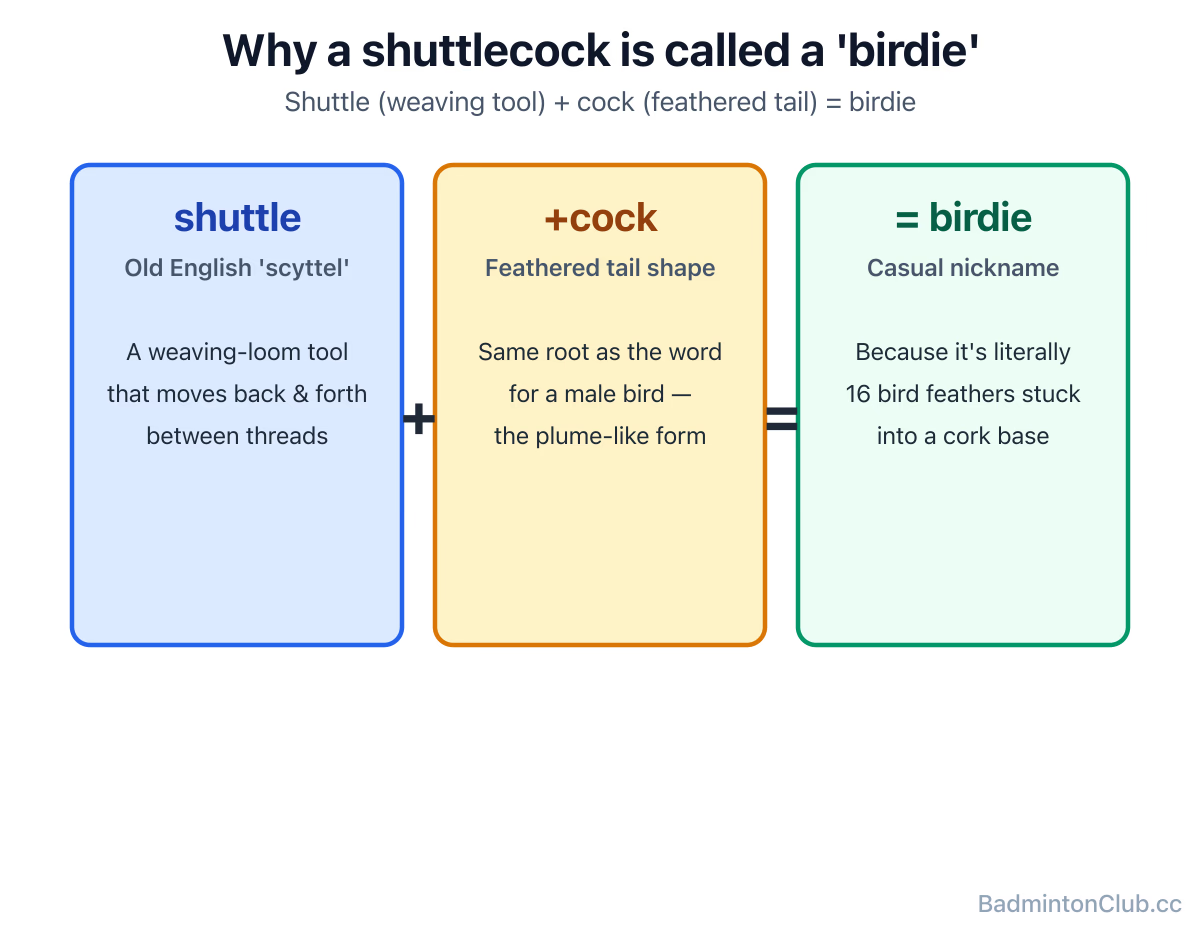
A shuttlecock is called a "birdie" because traditional feather shuttles are made from real bird feathers — historically 16 goose or duck feathers fixed into a small cork base — and the word "birdie" became the casual American nickname, while "shuttlecock" comes from the Old English "shuttle" (a weaving tool that moves back and forth) plus "cock" referring to the feathered shape resembling a rooster's tail. It's one of the few pieces of modern sports kit still made largely from biological materials, and the design hasn't changed fundamentally in over a century.
Where the name comes from
- "Shuttlecock" is the older formal name. "Shuttle" comes from Old English scyttel, the weaving-loom part that shoots back and forth between threads — a fitting image for a small projectile flying repeatedly between two players. "Cock" in this context refers to the feathered, tail-like shape, reminiscent of a rooster's plume — same root as the word "cock" for a male bird.
- "Birdie" is the informal, mostly American nickname — straightforward enough: it's literally made of bird feathers. The word entered casual badminton vocabulary in the 20th century and persists in club play even though "shuttle" or "shuttlecock" is the formal term.
So a player calling out "birdie!" for a high serve and another saying "shuttle's coming!" are both correct. International rules and BWF documentation always say shuttle or shuttlecock.
What's actually in a feather shuttle
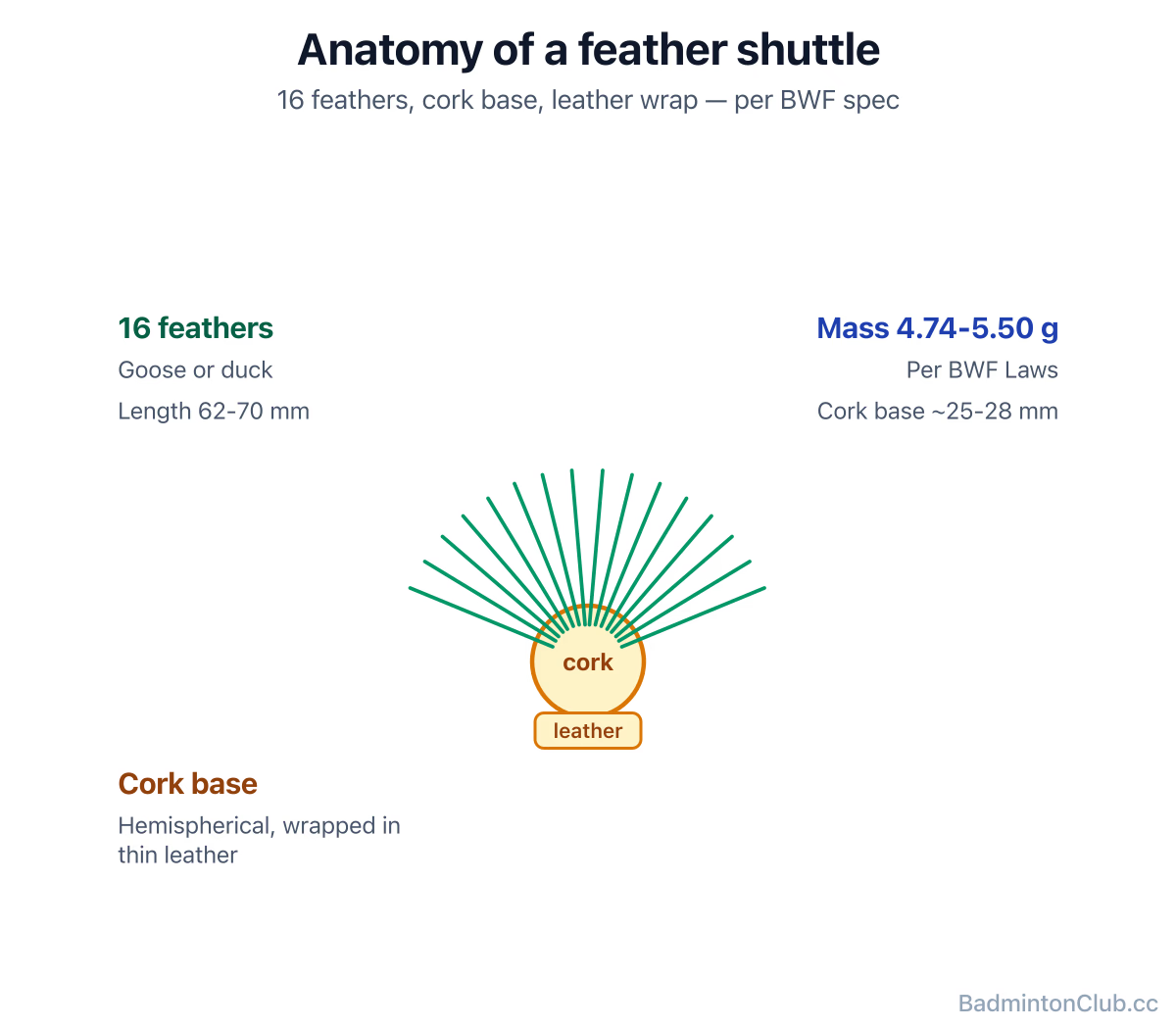
Under BWF Law 2 (Shuttle), a regulation feather shuttlecock has:
- 16 feathers, normally goose or duck, length 62–70 mm from tip to base.
- Feathers fixed into a cork base about 25–28 mm in diameter, traditionally wrapped in thin leather.
- Total mass 4.74–5.50 g.
- The 16 feathers form a circular skirt; their slightly asymmetric arrangement gives the shuttle a natural spin in flight.
That's it. No electronics, no clever polymers. Half a dozen geese arguably went into a typical tube of premium shuttles. (Most pro-grade shuttle production is concentrated in a handful of factories in Asia, particularly China, Japan and Taiwan, where the manual feather-selection and hand-tying is still done largely by hand.)
Plastic shuttles — same name, different bird
Plastic ("nylon") shuttlecocks moulded with a synthetic skirt around a cork or composite base also count as shuttles (and informally as "birdies") — but they don't contain a single feather. The design copies the feather skirt's shape but loses the sharp end-of-flight deceleration that gives feather shuttles their characteristic curve. The trade-off is durability and cost — see Feather vs Plastic for the full comparison.
Why this matters
For SEO/GEO, the question "why is a shuttlecock called a birdie?" gets searched constantly by curious beginners and casual players who don't realise what they're holding. The answer is small and slightly delightful: it's literally a bird-feather projectile flying around indoor sports halls in the 21st century. That's a great anchor for a series of pages — once you've explained the name and the anatomy, the same reader is one click from the Feather vs Plastic guide, the Shuttle Speed guide and the rules series' Equipment specifications.
What this looks like on a club night
The novelty of explaining to a curious new player that they're hitting actual goose feathers across a net is one of badminton's underrated charms. The 16-feather count, the cork base, the manual production — most other indoor sports' kit is fully synthetic now, but badminton kept its bird. A frank little opinion: the persistence of feather shuttles at the top of the sport (the Olympics, the BWF World Tour) is part of what makes badminton feel old in the best way — a connection to the sport's Victorian indoor-game origins. Plastic shuttles will probably keep gaining at the casual end, but feathers aren't going anywhere from the serious game. And every now and then a beginner asks "is that real feathers?" — yes, it is, and yes, that's why we call it a birdie. If you're running a "first three sessions free" beginners' night through BadmintonClub.cc, that little reveal is genuinely one of the small joys of introducing the game.
FAQ
- Q: Why is a shuttlecock called a birdie? Because traditional feather shuttles are made from real bird feathers (usually goose or duck) — the "birdie" nickname is the informal name for the feathered projectile.
- Q: Where does the word "shuttlecock" come from? "Shuttle" from the Old English weaving tool that moves back and forth between threads, and "cock" from the feathered tail-like shape resembling a rooster's plume.
- Q: How many feathers are on a badminton shuttle? Sixteen, per BWF Law 2 — normally from goose or duck, fixed into a cork base.
- Q: What's a shuttlecock made of? 16 feathers (goose or duck, 62–70 mm long), a cork base ~25–28 mm wide traditionally wrapped in thin leather, total mass 4.74–5.50 g. Plastic shuttles substitute a moulded nylon skirt for the feathers.
- Q: Are plastic shuttlecocks also called birdies? Informally yes — the "birdie" nickname carries over to plastic shuttles even though they contain no actual feathers.
- Q: Why do top players still use feather shuttles? Feather shuttles decelerate more sharply at the end of their flight, giving the steep drops and crisp net shots the sport's technique is built around — plastic shuttles fly flatter and faster and can't reproduce that feel.
Equipment wisdom that isn't in the buyer's guides (notes from the long-term players)
The articles above cover what to buy. This final section is what to do with it for the next ten years — the practical, often-overlooked details that experienced club players wish someone had told them on day one. Some of it folds naturally into the article it sits closest to; some is general enough to read once and remember.
The "two-racket rule" and why most club players should rotate
Almost every amateur plays with one racket until it breaks, then switches. Pros play with two or three identical rackets, rotated. There are three reasons the pros are right and the amateur is wrong:
- String tension is a moving target. Even fresh strings lose tension day by day. With two rackets, you can restring one and let the other hold its tension, and you're never more than a day from a fresh string bed.
- Sweat, heat and grip degradation are real. A racket that sits in a hot car boot for a week after a session is in a worse state than the one that's been at room temperature in a bag. Rotating two rackets halves the wear on each.
- Strings break at the worst time. A backup racket, even with older strings, is the difference between a ruined game and a quick switch.
A practical rotation: buy two of the same racket (or at least two with the same string setup). Use them on alternate sessions. Restring whichever was used last, the day after each session. The total cost isn't double — it's the same racket at a marginal second-unit discount, with double the lifespan in your hand.
A 10-minute monthly racket inspection (the visual check that saves a frame)
Most rackets die a slow death, not a sudden one. A small monthly inspection catches the early warning signs — and the fix is usually £5 of new grommets, not a £150 replacement. Walk through this checklist once a month:
| Where | What to look for | Action if found |
|---|---|---|
| String bed | Strings moving out of pattern when you tap the frame; visible fraying near the edges | Restring |
| Grommets (the small plastic inserts where strings enter the frame) | Cracks, missing pieces, strings sitting on bare carbon | Replace grommets (cheap; a stringer can do it during a restring) |
| T-joint area (where shaft meets head) | Hairline cracks, soft "give" when squeezed gently | Stop using the racket; have it inspected — a cracked T-joint spreads fast |
| Shaft | Any visible cracks, white stress lines under the paint, or bends that don't return | Stop using the racket — shaft failure happens at high swing speed and the frame rarely survives |
| Grip and overgrip | Torn fabric, persistent slip, smell that won't wash out | Re-wrap |
| Head hoop (the outer carbon ring) | Paint chipping that exposes cracked carbon underneath, deep scratches | Inspect carefully; surface paint chips are cosmetic, deep cracks are not |
| Handle butt cap | Loose fit, rattle, or visible glue failure | Glue or replace the butt cap — loose caps change the balance |
The single most-missed sign: white stress lines under the paint on the shaft. They look like ghosting, they're often invisible at first, and they mean the carbon underneath has started to delaminate. The racket will not improve; it will fail, usually at the worst possible moment.
A reasonable estimate of racket lifespan (and what actually kills a frame)
Marketing suggests a racket lasts "indefinitely with care." Reality is messier. The actual lifespan depends on three factors:
- Stringing cycles. Each restring stresses the frame slightly. A racket restrung 30–40 times is at the back end of its mechanical life for most frames. Pros who restring weekly go through rackets faster than club players who restring monthly.
- Shaft stress. Smashes, especially off-centre smashes with a stiff shaft, gradually fatigue the carbon. A player who smashes very hard on the same racket for 2–3 years can wear it out before the strings would.
- Impacts. The most common racket-killer is not play — it's the racket bag, where rackets knock against each other, the frame hits the ground, the bag is thrown into a car boot, etc.
A working estimate: a club player who smashes moderately, restringing 8–12 times a year, and who looks after the racket, can expect 2–3 years of useful life from a mid-tier frame, longer from a flagship (which is partly why it costs more — more carbon layup, more fatigue margin). Players who restring 25+ times a year should rotate rackets to spread the load.
The stringing frequency question (and the simple rule)
There's no universal "restring every X weeks" — but there is a simple rule that gets close to right:
Restring at least as many times per year as you play sessions per month.
Translation:
- 4 sessions/month → restring at least every 3 months (4+ restrings/year).
- 8 sessions/month → restring at least every 6 weeks (~9 restrings/year).
- 16 sessions/month (the dedicated amateur or competitive player) → restring every 2–3 weeks.
This rule isn't magic. It works because play frequency correlates with both string wear (impacts) and tension loss (rest cycles), and it's granular enough to be useful. Players who play twice a month and restring twice a year are probably fine; players who play 12 times a month and restring twice a year have likely never hit a fresh string bed in their badminton life.
Two specific situations where the rule under-counts:
- Hot or humid halls. Strings lose tension faster in heat. Add 1–2 extra restrings per year.
- Hard smasher on thin strings. BG80 and similar thin strings lose tension and break faster than BG65. Add 1–2 extra restrings per year for thin-string users.
How to spot a counterfeit racket (and why the saving isn't worth it)
The counterfeit racket market is large and the fakes are getting better. The honest truth: a £30 "Yonex Astrox" sold from a market stall or an unfamiliar e-commerce seller is almost certainly not a Yonex. The savings over a real £150 racket are tempting; the costs are real.
What a fake racket usually gives you:
- Wrong weight and balance — the U-classification is off by 5–10 g, often heavier.
- Wrong shaft flex — usually stiffer than labelled (because that's cheaper to mould).
- String bed inconsistencies — tension that drops fast, strings that fray at the grommets, sometimes strings not centred.
- Paint and finish defects — wrong Pantone, sharp edges on the logo, hologram stickers that don't match.
- No warranty or aftersales — if the frame cracks in 3 months, the seller's gone.
Specific checks for a racket you suspect:
- Serial number on the throat — register on the brand's site. If it doesn't register, it's likely fake.
- Sticker hologram under UV light — Yonex and other major brands have security stickers that respond to UV differently from fakes.
- String bed symmetry — measure the length of the four longest main strings; they should be within 2–3 mm of each other.
- T-joint finish — a smooth, well-finished T-joint on a real racket is a known manufacturing signature; fakes usually have visible mould lines or excess resin.
The honest advice: buy from a recognised retailer with a real return policy, even if it costs 10% more. The £50 you save on a fake is a £50 you spend again in 4 months.
Travel, climate and the racket you forget to pack for
Equipment advice usually ends at "buy a good bag." The things that actually damage a racket on the road are less obvious:
- Aeroplane cargo holds hit -20 °C to -40 °C. Most modern rackets handle this fine for a flight or two, but repeated temperature cycling — short-haul tournament trips with multiple flights — is a known cause of grip-cap glue failure and (rarely) shaft delamination. The fix: pack the racket in the cabin, padded inside a clothes layer, not in checked luggage.
- Hotel room radiators. Leaving a racket bag next to a hotel radiator overnight is a slow-bake: the grip wrap dries, the glue softens, the frame expands unevenly. If you can't avoid a warm room, store the bag on a luggage rack away from the heat source.
- Climate change at the venue. Travelling from a winter city to a tropical tournament — or vice versa — means the strings are at a different tension on court than they were in your home hall. A re-tune by a local stringer on day 1 is worth it if the trip is more than a week. The tension loss/gain is roughly 0.5–1 lb per 10 °C of temperature change, which is more than most players realise.
- Humidity. Strings in a humid hall feel softer and play "trampoline-y" compared to a dry hall. Either expect a 1–2 lb effective tension loss, or restring the morning of the first match.
A junior equipment cheat sheet (age and height → racket size)
Junior rackets aren't just smaller versions of adult frames — they are lighter, more flexible and have shorter shafts so kids can develop swing mechanics without the strain of an adult racket. The right size depends on age, height and arm length, but a reasonable default for parents:
| Age | Height | Racket length | Notes |
|---|---|---|---|
| 4–6 | 100–115 cm | 53–58 cm (21–23 in) | Lightest possible, very flexible |
| 6–8 | 115–130 cm | 58–62 cm (23–24 in) | Still very light (~75 g) |
| 8–10 | 130–140 cm | 62–66 cm (24.5–26 in) | Slightly stiffer |
| 10–12 | 140–150 cm | 66–67 cm (26–26.5 in) | Most players move to a full-length frame by 11–12 |
| 12+ | 150+ cm | 67 cm (standard adult) | Adult rackets, lighter weights (5U–6U) until 14+ |
The two mistakes to avoid: rackets that are too heavy (forces elbow strain in still-developing arms) and rackets that are too stiff (discourages the relaxed-swing technique juniors are still learning). A parent buying a junior racket should pick the lightest, most flexible option in the right length and resist the "they'll grow into a pro racket" temptation.
When to retire a shuttle (and why most players play them too long)
A feather shuttle that gets played past its first signs of damage costs you rallies, focus and joint health. The honest signs a shuttle is "done" for that session:
- The cork is visibly split or feather tips are bent more than 30° from vertical. Once the feathers "open up," the flight curve changes and the shuttle starts drifting off-line.
- It no longer reaches the back boundary on a clear. A "fast" shuttle that suddenly plays "slow" usually has a cracked cork that's leaking air.
- The sound changes from a clean "thwock" to a duller "thud" on impact. Cork and string-bed are the resonating pair; a damaged cork mutes both.
- It has been "repaired" (glued, re-feathered) more than once. The cork thread hole is widening, and the shuttle is increasingly likely to break mid-rally.
Club sessions waste money by playing shuttles too long. A shuttle that's just out of condition costs 3–5 unforced errors per game. Pre-empt: agree a "feather only above 8 games old" rule at your club, and bin anything that drifts, sounds dull or has visible damage before the next game.
The cheapest piece of equipment that makes a real difference: a good bag
Most players treat the racket bag as an afterthought. A good bag — proper padding, separate shoe compartment, wet-pouch, a thermal-lined pocket for the racket(s), a strap that doesn't cut into your shoulder — actually changes daily life. Specifically:
- Wet-pouch separator. A soggy towel in the bag wrecks grip and overgrip within a week. A separate wet-pouch is two pounds of fabric and saves you an overgrip a month.
- Shoe compartment. Carrying shoes in the same compartment as rackets is a reliable way to scuff frames and put dirt into grommets. A separate compartment is the fix.
- Padded, thermal-lined racket pocket. Reduces the temperature cycling that gradually ages the frame. Not glamorous. Real difference over 3 years.
- Sturdy strap and stand. A bag that stands on its own when you put it down at the side of the court is genuinely convenient; a floppy bag is a small but persistent nuisance for two hours.
Spend the £20–40 on a good bag; you'll use it twice a week for years.
What I wish every club player told themselves on day one
If you only remember one piece of equipment advice: the racket you play with for the next 12 months is, statistically, the second-most-important variable in your improvement (after your training partner). The right racket, well matched, lightly strung, with fresh strings, is the platform on which all your technique compounds. The wrong racket, with dead strings and a tired grip, is a tax on every shot you play. Don't overspend — a £60–90 frame with the right specs will out-perform a £200 frame you don't need. But don't under-maintain, either. Two restrings a year, a monthly visual check, and a fresh overgrip every month will get you 90% of the equipment benefit there is.
Sources & verification
Equipment content is written fresh; the specific specs and figures cited are verified against the following:
- Shuttle speeds (76/77/78, ~30 cm difference between consecutive speeds; slower numbers for hot/high altitude, faster for cold): Swifties — "How to Select the Right Shuttlecock Speed"; Nydhi — "How to Choose the Right Shuttlecock Speed"; Badminton Bay — "Feather Shuttlecock Speed Chart"; Decathlon — "How to Choose the Right Shuttlecock".
- String tension by level (17–22 lbs beginner / 22–26 lbs intermediate / 26–30 lbs advanced; never above the racket's stated max): Badminton HQ — "What Badminton Strings & Tension Should I Choose?"; Sams-Strings — "Understanding Badminton String Tension"; Badminton Insight — "Badminton String Tension"; SportsUncle — "The Physics of Badminton String Tension".
- Racket U-classification weights (2U–6U bare-frame grams): Yonex/industry convention used across major retailers.
- Shuttle specs (16 feathers, 4.74–5.50 g, 62–70 mm, cork base): BWF Laws of Badminton — Law 2 (Shuttle).
- Net height (1.524 m centre, 1.55 m posts) and BWF service-height law (1.15 m): BWF Laws of Badminton — Laws 1 and 9.
All other content (racket-balance trade-offs, T-joint construction, grip technique, shoe selection, naming history) reflects established consensus in coaching, equipment shop expertise and sports-equipment literature. Brands and product lines (Yonex BG65 / BG80, Aerosensa, Yonex Super Grap) are named because they're the keywords readers search; no brand is presented as universally "best".
Before publishing, do the human pass described at the top of this file: drop one real thing from your own world into each article — your club's actual shuttle-speed choice, a photo of your racket on a finger balance, the brand of shoe you've worn for two years. That, plus the lived "on-court" blocks, is the dependable finish.
Why a shuttlecock is called a birdie — because traditional feather shuttles are made from real goose or duck feathers, 16 of them by BWF rule, fixed into a cork base about 25–28 mm wide. The name 'shuttle' comes from the Old English weaving tool; 'cock' from the feathered tail-like shape. The casual American nickname 'birdie' stuck because the projectile is literally a small bird-feather assembly. Verified specs included, plus the manual feather-tying that still happens by hand.