Four-On Four-Off Badminton: The Fairest FIFO Rotation for Crowded & Beginner Clubs
6 June 2026
Four-On Four-Off is a first-in-first-out badminton rotation: when a game ends, all four players leave and the next four in the queue come on. It delivers the most equal court time and the fewest arguments, which is why crowded beginner, school and university clubs rely on it. (In BadmintonClub.cc, the Peg Board mode gives you a transparent digital FIFO queue with a captain pick.)
How it works
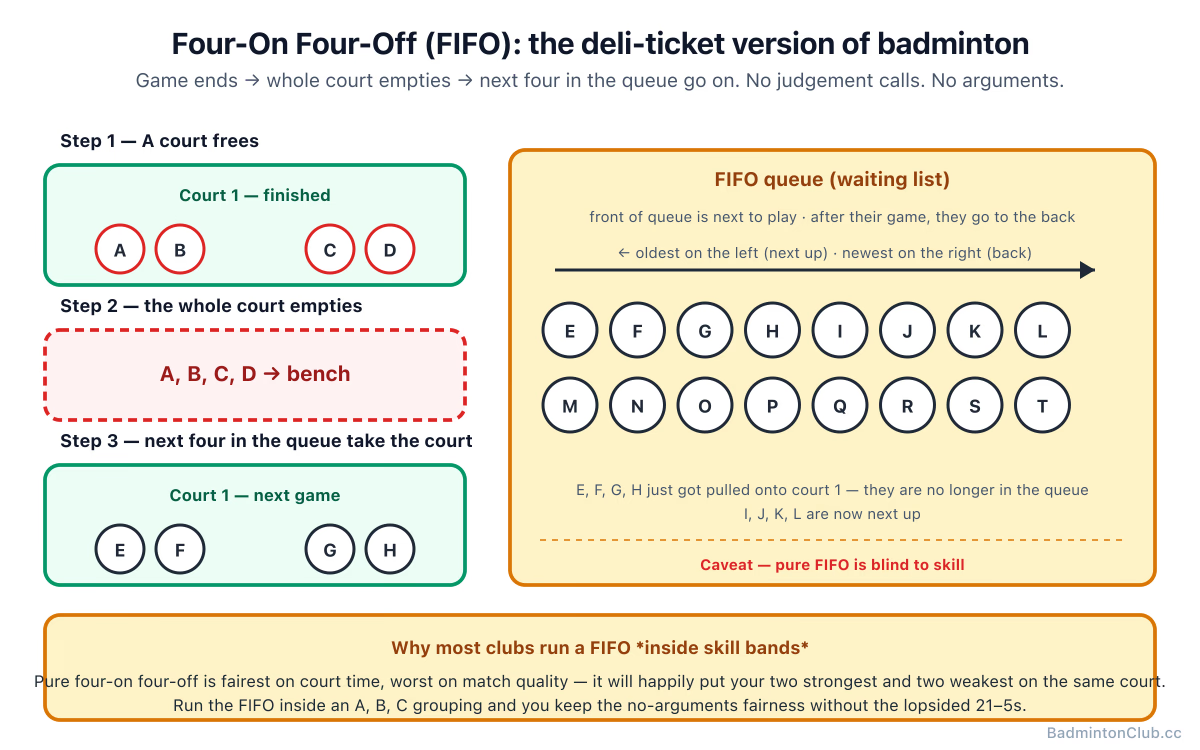
Game ends → the whole court empties → the next four in the queue come on. Pure FIFO; everyone cycles in strict order.
Is it really "the fairest"? A straight answer
When people ask online "what's the fairest badminton rotation system?", four-on four-off is the honest answer if you define fair as "equal court time and no arguments." Nothing else distributes minutes more evenly — it's pure first-in-first-out, the same logic as a deli ticket queue, and there's no judgement call for anyone to resent. But "fair" has two meanings and this only nails one of them. It's blind to match quality: it'll happily put your two strongest and two weakest players on the same court for a lopsided 21–5, then do it again. So the real answer is: four-on four-off is the fairest on court time, the worst on competitiveness, and the trick most good clubs use is to run it inside skill bands — a FIFO queue per A/B/C group — so you get the no-arguments fairness without the mismatches. Its DNA, by the way, is school PE: a clipboard, a list of names, "next four on." That's why it scales to a packed sports hall without a single peg.
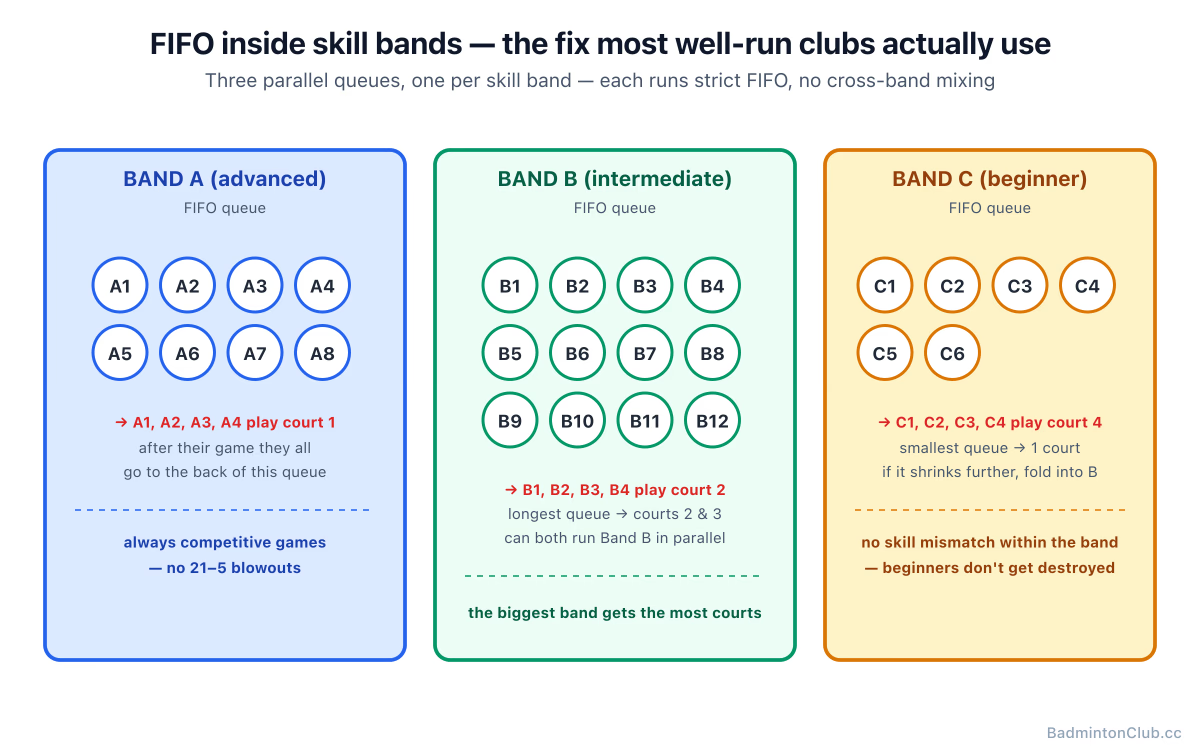
The skill-band version is what most "FIFO clubs" actually run in practice. Three paper lists, one per band, and a teacher/lead rotating between them. The cross-band interaction — beginners and advanced players playing each other — disappears, which is the cost: less social mixing, more predictable games. Most clubs accept that trade because the alternative (a 21–5 every round) drives beginners out faster.
Pros and cons
Pros: ✅ extremely fair court time · ✅ no disputes · ✅ scales to big crowds. Cons: ❌ interrupts good games · ❌ no skill balancing · ❌ less competitive continuity.
Examples
- 3 courts, 18 players: queue A–R fills courts; finished groups go to the back.
- School club, 24 kids: teacher calls numbers off a list — zero disputes.
- FIFO + on-court re-draw (1&3 vs 2&4) for partner variety.
Where it's popular & estimated share
Common in UK and NZ schools/community clubs; ~10% globally, often as the policy underneath a peg board.
FAQ
- Q: Is four-on four-off the fairest system? For equal court time, yes — but it ignores skill.
- Q: Best for beginners? Yes — simple and even.
- Q: How is it different from a peg board? Peg board is the tool for running a FIFO queue; four-on four-off is the policy.
- Q: Does it balance matches? No — use a balanced mode like timed rotation for that.
- Q: Good for big numbers? Excellent — it scales smoothly.
- Q: Can I keep good games going? No — every game ends on rotation; pick a different system if continuity matters.
- Q: What if a player is mid-game with a friend and they want to finish? Honour it — let them play to 21 (or 15), and start the FIFO count from the next court-free moment. Strictness on this is the fastest way to lose members.
- Q: How do I avoid the same 4 always queueing together? Rotate the bench order: ask the 4 waiting to split into 2+2 for the next game. Small move, big social upside.
- Q: Is this basically the same as a peg board? In policy, yes — a peg board is the tool for running a FIFO queue; four-on four-off is the rule the tool enforces.
Four-on four-off is the fairest badminton rotation for equal court time: every game ends, all four players leave, and the next four in the queue come on. This guide explains how strict FIFO works, why it suits beginner and school clubs best, how running it inside skill bands fixes the mismatch problem, and when to switch to a different system for competitive continuity.