Timed Badminton Rotation Done Right: Auto-Balanced Courts That Swap on a Timer (TimeSwap)
6 June 2026 · Badminton Fans
TimeSwap is a timed badminton rotation where every court plays for a fixed number of minutes, then all players swap to fresh, automatically balanced games. Instead of waiting for a game to "finish," a timer ends every round at once and the app re-allocates players across courts — balancing skill, evening out who's rested, mixing partners, and respecting gender rules. It gives you the predictability of timed games and the match quality of balanced matchmaking, without anyone running a board.
How a timed rotation works
In a classic timed rotation, games run to a fixed clock (commonly 12–15 minutes). When the buzzer sounds, everyone rotates regardless of score. This guarantees equal court time and predictable waiting — the reason busy public centres use it. The weakness of plain timed rotation is that the matchups are random: a 15-minute game can be a total mismatch. TimeSwap fixes exactly that.
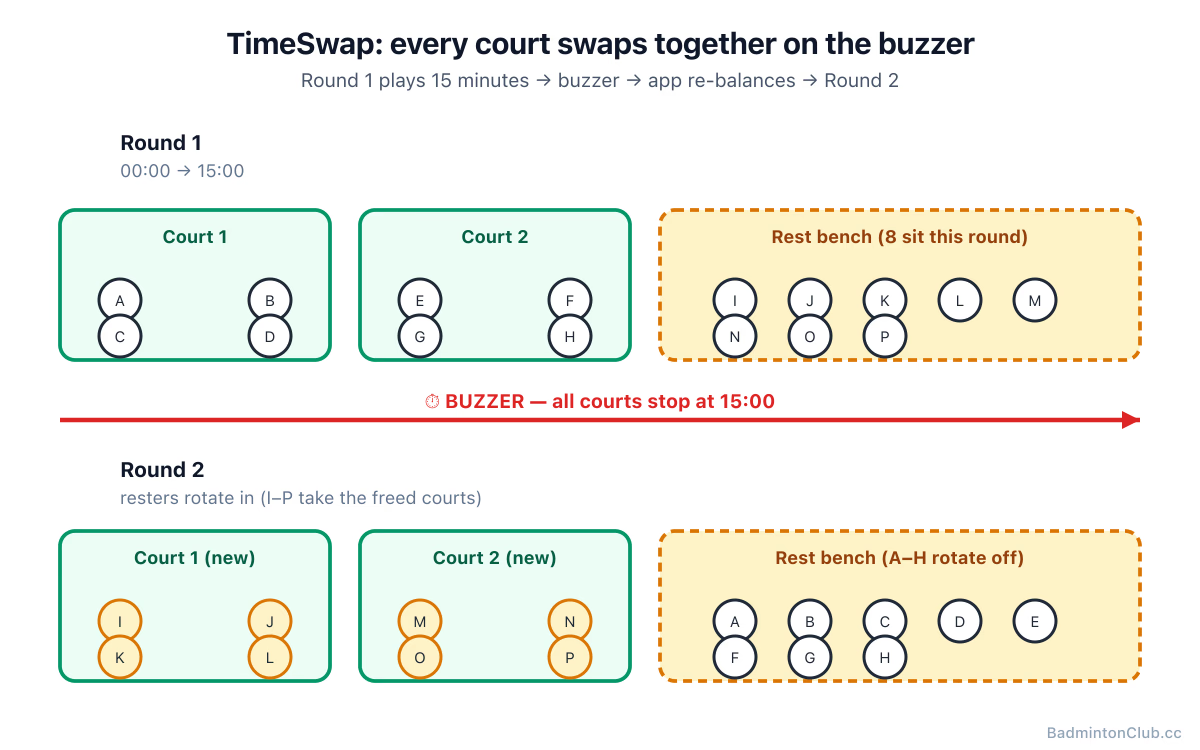
How TimeSwap works in the app
When you run a session in TimeSwap mode (timeswap), BadmintonClub.cc:
- Starts every court at once and counts down
minutesPerGame(you set it, e.g. 15). When the timer ends, the app auto-prompts a Swap to the next round (or you tap "Swap now"). - Re-allocates all available players each round through our balancing engine, which prioritizes, in order:
- Rest fairness — players who sat out most recently are seated first, so court time evens out.
- Skill grouping — players are grouped within a configurable skill-score difference so games stay close (with automatic tolerance widening if a perfect group can't be formed).
- Gender strategy — optional mixed courts / no-lone-female / females-together rules.
- Pairing variety — avoids giving you the same partner repeatedly.
- Retries with widening tolerance if a balanced board can't be built, and falls back gracefully so a round always gets generated.
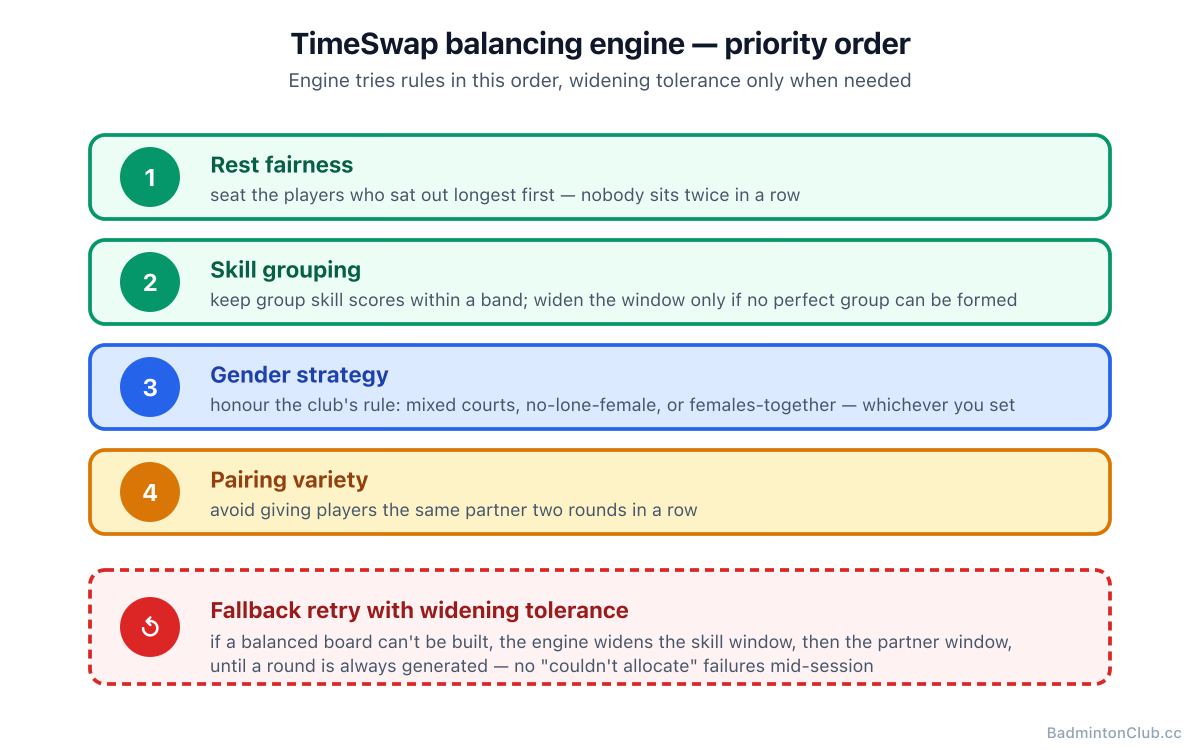
The result: every 15 minutes everyone rotates, the teams are close, nobody is stuck waiting twice in a row, and you didn't touch a peg board.
How the app handles the pros & cons
Timed rotation's two classic downsides are (a) games can end abruptly and (b) plain timers ignore skill. BadmintonClub.cc mitigates both:
- The abrupt-ending complaint is softened because the next game is already balanced and you're rotating into fresh opponents — there's always a "next" worth playing.
- The random-matchup problem is solved by the balancing engine (skill grouping + rest fairness + variety), turning a blunt timer into a fair, competitive rotation. If you want the same auto-balancing without a fixed clock, Suggest-a-Game offers on-demand balanced matchmaking instead.
- Court-time fairness is enforced in software (rest-count first), which a human with a stopwatch can't track across 30+ players.
In the app: set TimeSwap as your mode, choose players-per-court and minutes-per-game, toggle skill/gender/variety options, hit start. The timer and swap are automatic.
Field notes: what a 15-minute round actually does to a night
Two things nobody tells you about timed rotation until you've run it. First, the last 60 seconds go soft — once a pair is two or three points clear and the clock's nearly up, the long rallies stop and people start glancing at the buzzer. If your crowd is competitive, announce that the score at the buzzer stands, and if it's level you play a single golden point. It keeps the last minute honest. Second, stagger your court timers by about 30 seconds rather than starting all four at once — otherwise every court finishes together, sixteen people swarm the desk for shuttles and water at the same moment, and your clean 15-minute round bleeds into 17.
Here's the maths that makes the case for clubs that think a timer "wastes" court time. Take 24 players on 4 courts (16 on, 8 resting), 2 hours, 15-minute rounds → 8 rounds. Each round, 8 of 24 sit, so over the night an average player rests 8 × (8/24) ≈ 2.7 rounds and plays about 5.3 rounds ≈ 80 minutes of a 120-minute night — roughly two-thirds of the session on court, and never sitting out twice in a row. Try to beat that consistency by eye across 24 people and you can't; that's the whole argument for letting the clock and the engine run it.
One more thing nobody warns you about with a buzzer-driven night: the shuttle budget. A 15-minute timed game chews through about 1.5 shuttles between the four players — much faster than a "first to 21" game that averages 18 minutes. Across a 24-player, 8-round session that's roughly 24–28 shuttles per court over the night. Set the box by the door before the first buzzer, not after the third. And, less obvious, pick a sound the building won't ignore — most laptop speakers get drowned out by six rallies in a row. Phone-on-vibrate is the silent killer of timed rotation; if you can hear it, the rotation works.
Pros and cons
Pros
- ✅ Predictable, equal court time — buzzer-driven blocks.
- ✅ Balanced, competitive games (not random like a plain timer).
- ✅ Rest-fairness + partner variety enforced automatically.
- ✅ Zero live admin once configured — the practical answer to "how do badminton clubs manage court time" and the search for apps to manage badminton player rotation.
Cons
- ❌ Games can be cut off mid-contest (inherent to any timed format).
- ❌ Needs a visible device/screen running the timer.
- ❌ Balancing quality depends on reasonably accurate player skill ratings.
Three quick examples
- 24 players, 4 courts, 15-min rounds: 16 play / 8 rest each round; the 8 who rested come on first next round. Over a 2-hour session everyone plays ~50–60% of the time.
- Mixed social night: enable "mixed courts" — every board is 2 men + 2 women, re-balanced by skill each swap.
- Wide skill spread: widen the skill-score difference slightly so the engine can always seat everyone, while still keeping teams close.
Where it's popular & estimated market share
Timed rotation is widely used in New Zealand and Australian public/rec sessions and busy UK centres; estimated ~8–10% of clubs use a timer as their primary system globally — rising as clubs grow and value predictability. The balanced/auto-matchmaking layer on top (what TimeSwap adds) is the fast-growing modern category.
FAQ
- Q: How long should each timed badminton game be? Usually 12–15 minutes; 18 for stronger groups who want fuller games. TimeSwap lets you set
minutesPerGame. - Q: Isn't a timer unfair if you're mid-game and winning? It ends all games equally, so over a session it's the fairest on court time. TimeSwap also rotates you straight into a fresh balanced game.
- Q: Does TimeSwap balance teams by skill? Yes — it groups players within a skill-score window and widens tolerance only if needed, so games stay competitive.
- Q: How does it stop the same people sitting out repeatedly? It seats the most-recently-rested players first every round (rest fairness).
- Q: Will I keep getting the same partner? No — pairing-variety avoids repeat partners when possible.
- Q: How many players and courts does it suit? Great from ~12 up to 40+ players across 2–8 courts.
- Q: Do I need to report scores? No — TimeSwap rotates on the clock, not on results (unlike Winner Stays On, where the score decides who rotates).
- Q: What plan do I need? TimeSwap counts as one of your distinct rotation modes (Free = 2 modes, Premier = 4, Elite/Apex = unlimited).
- Q: What if my numbers don't divide by 4? TimeSwap handles odd remainders by giving the spare person a "rest" round and seating them first on the next swap — no organiser maths required.
- Q: Can I change the round length mid-session? Yes — bump it down to 10 minutes for the last 30 minutes of the night if you want a final quick-fire round for everyone.
- Q: Does this work for 8+ courts and 60+ players? Yes — the engine scales; the only practical limit is shuttle supply and how many courts your venue has.
TimeSwap is a timed badminton rotation that ends every court simultaneously on a buzzer and auto-balances the next round by skill, rest fairness, and partner variety — no peg board needed. This guide covers how the engine works, field-tested tips on shuttle budgets and golden-point rules, a court-time maths breakdown for 24-player sessions, and full pros, cons, and FAQ.