How to Rotate 5, 6, 7 or 8 Players on One Badminton Court (Fair Sit-Out Schedules)
6 June 2026
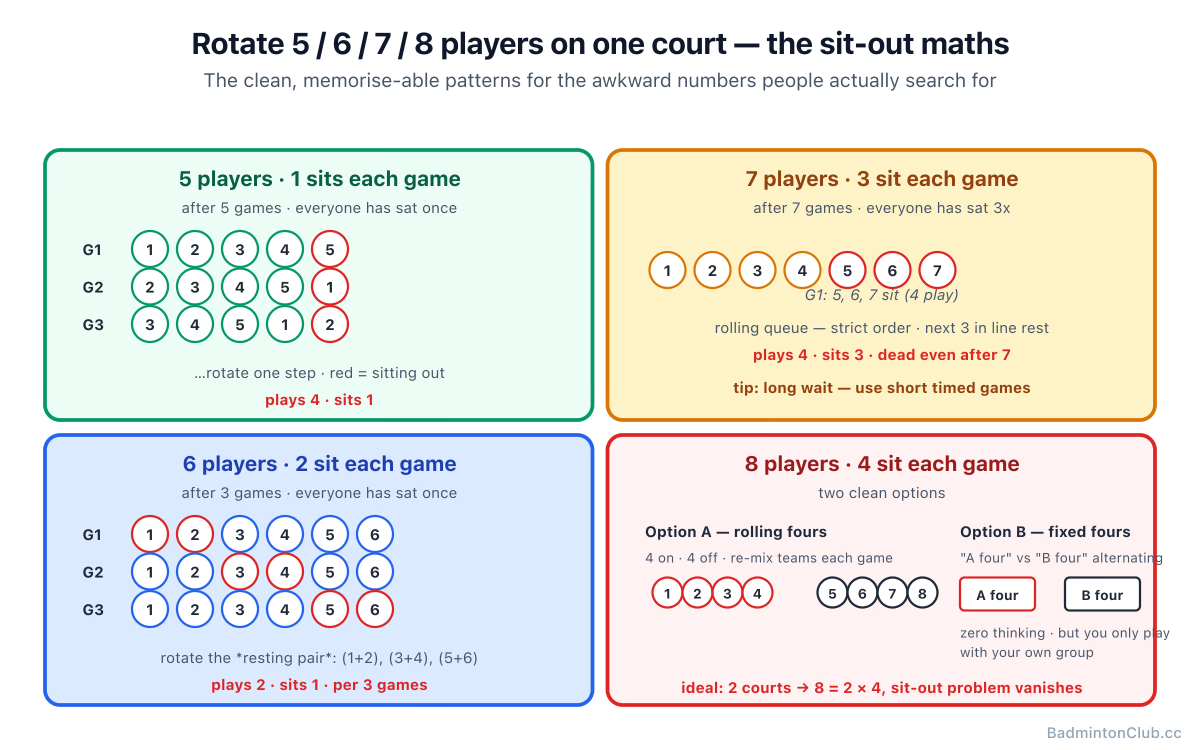
With one court and more than four players, the fair way to rotate is to fix a sit-out order and rotate it by one each game, so everyone sits out the same number of turns in the same predictable pattern. Doubles needs exactly four on court, so the whole problem is who sits, and in what order — get that into a simple rolling list and the bickering disappears. Here are the clean, memorise-able patterns for the common awkward numbers, the ones people actually search for when they're standing at the net with an odd group.
5 players on one court
One person sits each game. Number everyone 1–5 and rest them in that order: game 1 player 5 sits, game 2 player 4, and so on. After 5 games everyone has sat exactly once and played 4 — perfectly even. A nice extra: don't keep fixed pairs. Each game, the four who are on re-draw teams (e.g. the two who just came back on split up) so it doubles as partner rotation, not just a sit-out queue.
6 players on one court
Two sit every game. The trick that keeps it fair and social is to rotate the resting pair, not fix it: pair the sit-outs as 5+6, then 3+4, then 1+2, cycling so that over 3 games everyone has sat exactly once. Avoid the lazy version where the same two friends always sit together chatting — rotate who rests with whom and you also stop two cliques forming.
7 players on one court
Three sit each game — this is the number that feels most "crowded" on one court. Run a strict rolling queue of 7: each game the next three in line rest, then go to the back. Over 7 games everyone sits exactly 3 times and plays 4 — dead even, no judgement calls. With seven on a single court the wait is real, so this is the strongest case in the list for either grabbing a second court if one's free, or running short timed games (11 or 15 points) so the queue turns over faster — the latter pairs especially well with a timed court-swap system that automatically triggers the handover.
8 players on one court
Eight is the clean one: it's exactly two games' worth. Two ways to run it depending on your goal. Fairest/most social: treat it as a rolling 8 — four on, four off, and re-mix the teams each game so you're not playing the same three people all night (see four-on four-off rotation for the full FIFO queue logic). Simplest: split into a fixed "A four" and "B four" that alternate games — zero thinking required, but you only ever play with your own four, so use it only if people are happy in fixed groups. If two courts ever open up, eight players splits perfectly into two fours and the sit-out problem vanishes entirely.
A practical tip that turns this whole section from "abstract maths" to "goes smoothly on the night": write the order on the back of a shuttle tube. Number everyone 1–N, then every game whoever's sitting reads out "the next rest is players 3 and 4" — written down, no one's memory to fight, no one's feelings to manage. The other side of the same tip: don't try to memorise it. The clubs that run smooth single-court nights aren't running clever maths in their head; they've just got the rolling order written down somewhere visible.
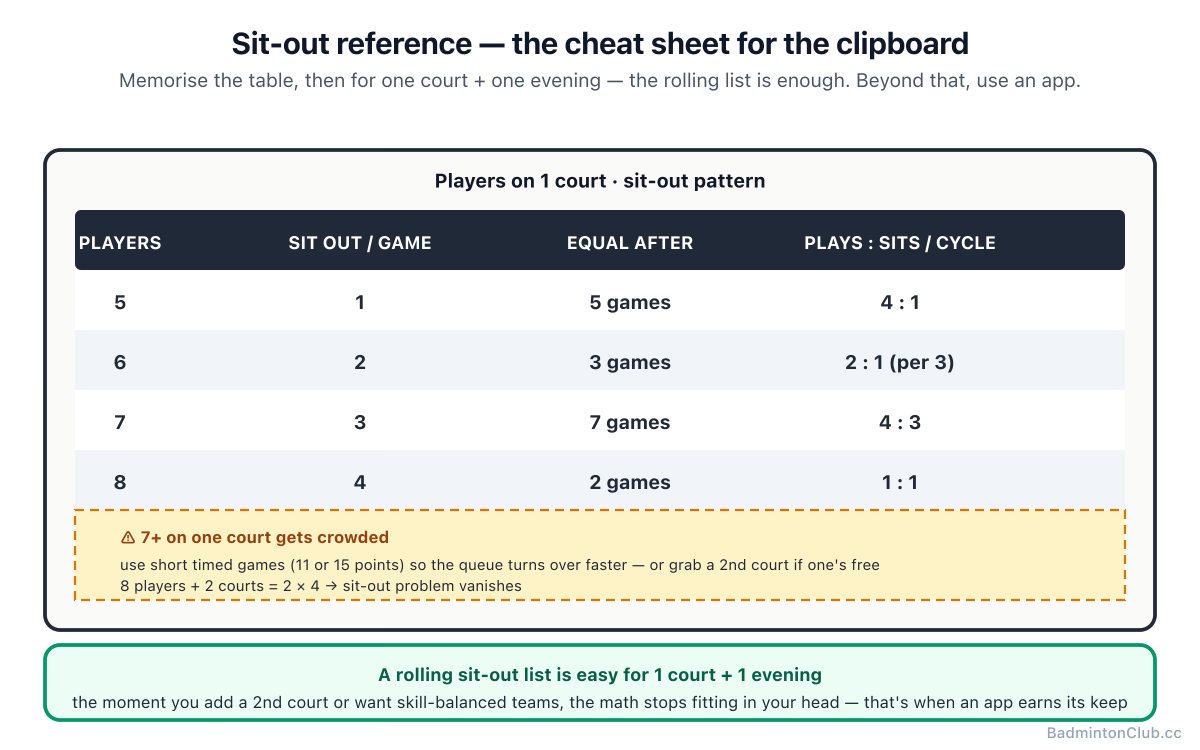
Quick sit-out reference
| Players on 1 court | Sit out each game | Everyone equal after | Plays : Sits per cycle |
|---|---|---|---|
| 5 | 1 | 5 games | 4 : 1 |
| 6 | 2 | 3 games | 2 : 1 (per 3) |
| 7 | 3 | 7 games | 4 : 3 |
| 8 | 4 | 2 games | 1 : 1 |
Doing this every week? A rolling sit-out list is easy for one court and one evening; it gets fiddly the moment you add a second court or want skill-balanced teams on top of fair sit-outs. That's the point where a rotation app earns its keep — BadmintonClub.cc tracks who's rested and balances the four who play, so you're not running a queue in your head.
FAQ
- Q: How do you rotate 6 players on one badminton court? Two sit each game; rotate the resting pair so that over three games everyone has sat exactly once.
- Q: What about 5 players on one court? One sits each game in a fixed 1–5 order; after five games everyone's sat once.
- Q: 7 players on a single court — is that too many? It works (three sit each game, even after 7 games) but the wait is long; consider short timed games or a second court.
- Q: Fairest way to split 8 players on one court? Rolling four-on four-off with re-mixed teams; or two fixed fours if people prefer set groups. Two courts is ideal if available.
- Q: How do I stop the same people always sitting out? Use a written rolling order (or an app) instead of "whoever volunteers" — volunteering always falls on the same polite few.
- Q: Singles instead? With odd numbers some clubs run singles on part of the court, but for 5–8 players, doubles with a sit-out queue keeps the most people moving.
- Q: What about 9 players on one court? Add a 2nd court if you can — 9 on 1 is just 7 with a queue of 5, and the wait gets punitive. If you can't, run 4-on/5-off with rotating partners; "everyone plays with everyone" is no longer the rule.
- Q: Can the same two people "volunteer" to sit out together? Sure, occasionally — but don't let it become a pattern. Clubs that allow it always end up with the same polite pair sitting out, which is just winner-stays-in-reverse.
- Q: How do I count games so I know when the rotation is even? Use a small stone or a counter on the bench — one tap per game, and the table above tells you how many games until everyone's sat the same number of times.
Publishing checklist (per article)
- Author = superadmin (user id 6) — every record is
authorType: 'member',authorId: 6(already set), matching themembers/6/article/...image paths. These are the website's official public articles, published by the superadmin. - Leave
articleSlugunset —createArticle()generates it (PascalCase-hyphenated + suffix). - Part A modes →
sitePriority: 10,recommendation: 'featured'. Part B →sitePriority: 7,'normal'(except Hybrid, which is'featured'to push it). status: 'published'+visibility: 'public'for ALL 14 articles (including Suggest-a-Game). These two, plussitePriority >= 5, are the exact gate for the/articleroute — see "Display on/article" above.- Set
publishedAtto a real timestamp (e.g.NOW()) on insert — required for it to read as live in author feeds and JSON-LD, even though the featured gate doesn't check it. type: 'article'on every record — needed for the/article/type-articlehub andisArticleTypeto accept it.- Add a
coverImage(hero) for the Part A modes, or let the first body image become og:image (the CDN AVIFs are already in each body). - Body is markdown — paste each
### Bodysection as thebodyvalue; image links already point athttps://cdn.badmintonclub.cc/members/6/article/.... - Internal links: in each Part B article, keep the cross-link to the matching Part A mode (already written in). On a pillar page, link all articles back to this guide.
- Verify
/articleafter insert — run the 4-step smoke test in "Display on/article": tag hub, type hub, one detail URL (200 + images render), and confirm all 14 articles are present. - Human pass before publishing (do not skip): each article carries an original block ("Field notes", "From the club floor", "A house rule worth stealing", etc.) — that's the unique, not-on-other-sites material. Before posting, drop in one real specific from your own club (a venue name, a real headcount, a photo of your actual board, a member quote). That's what makes it read as genuine human work; no wording trick substitutes for one real detail or photo.
Suggested publish order
- Hybrid (B9) — highest-intent "too many players / best system" search, links to TimeSwap.
- Peg Board (A3) and Winners Stay (A2) — highest-volume named terms (peg/paddle/king-of-the-court), and they're ours.
- TimeSwap (A1) — the conversion piece.
- B10 "Rotate 5/6/7/8 players on one court" — strong long-tail, pulls in single-court searchers and links to TimeSwap.
- Mexicano (B8), Americano (B7), Round Robin + Swiss (B6) — trending modern formats.
- Winner Splits (B1), Four-On Four-Off (B2), Challenge Court (B3), Ladder (B4), Box (B5).
- Court Release (A4) and Suggest-a-Game (A5) — both publish now (A5's article runs "coming soon" copy; refresh it when the mode actually ships).
Sources consulted (regional/format grounding)
- Timmins Porcupine BC — Peg Board System · Boulder BC — Peg Board · Nomads BC rules · Eagles & Sidcup — rotation policy
- BadBoard — automated peg board · Sportplan — King of the Court drill
- Americano vs Mexicano comparison · PadelMix — Mexicano rules
- Racquet Sports Institute — Asian badminton infrastructure
Reminder: market-share figures are informed estimates, not measured statistics — keep them framed as "estimated/roughly" in published copy.
Fair sit-out rotations for 5, 6, 7, or 8 players sharing a single badminton court — rolling patterns that keep everyone equal without arguments. Covers the exact cycle length per player count, practical tips for writing the order down, and when a second court or a rotation app makes more sense.