Best Badminton Club Rotation System: The Hybrid Setup Busy Clubs Actually Use (20–40 Players)
6 June 2026
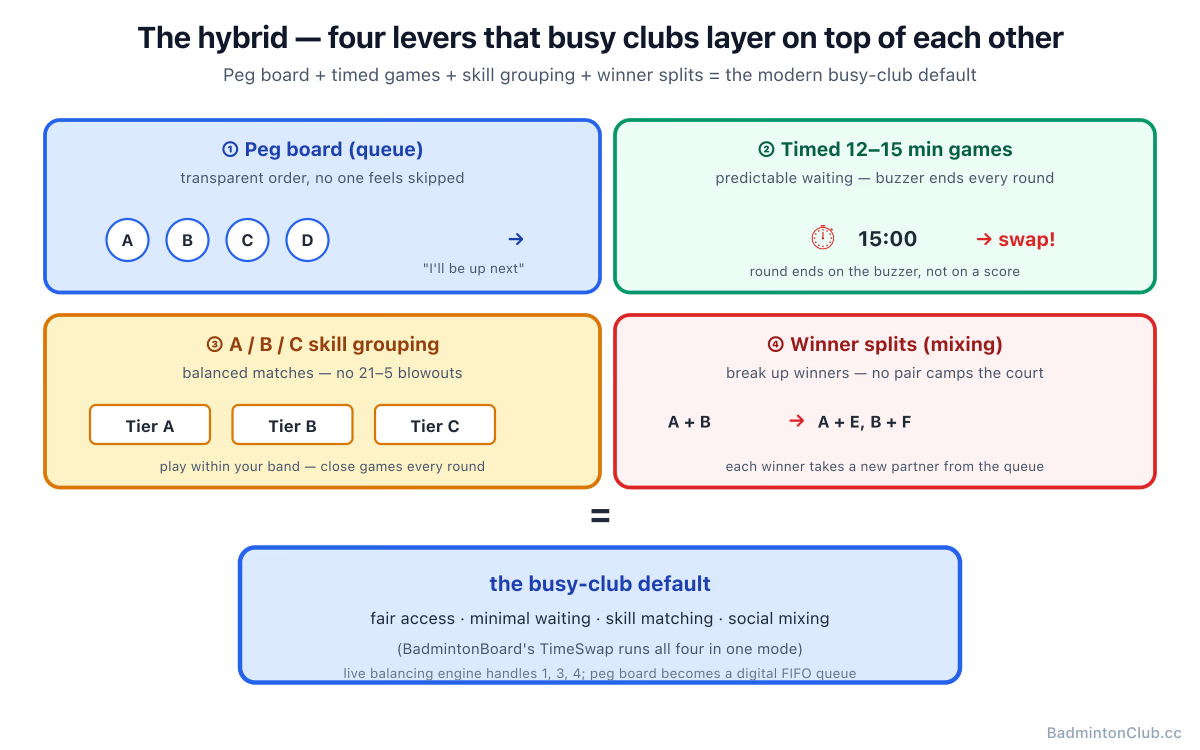
The best badminton rotation for a crowded club isn't one system — it's a hybrid: a fair queue, timed games, skill grouping, and partner mixing combined. Most successful clubs of 20–40 players on 3–6 courts blend a peg-board/queue for fair access, timed 12–15-minute games for predictability, A/B/C skill grouping for balance, and winner-splits for social mixing. (In BadmintonClub.cc, TimeSwap delivers this hybrid automatically — timed swaps + skill-balanced, rest-fair, variety-aware boards in one mode.)
How the hybrid works
Layer four ingredients: (1) a transparent queue/peg board for fair court access, (2) timed 12–15-min games for predictable waits, (3) A/B/C skill grouping for balanced matches, (4) winner-splits for mixing and no monopolies. If you want to understand how the timed swap component works in isolation first, see Timed Badminton Rotation Done Right.
Pros and cons
Pros: ✅ fair access + minimal waiting + skill matching + social mixing together · ✅ no court monopolies · ✅ scales to crowded nights. Cons: ❌ more moving parts to set up manually · ❌ best run with an app or experienced organizer.
"How do you manage too many players on too few courts?" — the honest answer
This is the most-asked question in every badminton club Facebook group and on Reddit, and the disappointing-but-true answer is: **you can't make 30 people on 4 courts feel like 16 people on 4 courts — you can only make the waiting fair and predictable instead of random and resented.** Every workable setup is some mix of four levers, and which one you reach for tells you which complaint you're trying to kill:
- People feel they wait too long and unevenly → add a timer (predictable blocks) and a queue (visible order).
- Games are mismatched and not fun → add skill grouping.
- The same pairs hog and dominate → add winner-splits or a win cap.
The clubs that have genuinely solved "too many players, too few courts" aren't running one clever system — they're running all four levers at once, which is what "hybrid" means. The reason it used to be rare is that doing all four by hand needs a dedicated, slightly bossy organiser with a clipboard and a stopwatch. The reason it's becoming the default now is that an app holds all four at once and just tells people where to go.
Worked example
24 players, 4 courts, 15-min rounds: 16 play / 8 wait; peg-board within two skill bands; winners split on re-entry. Per player: ~10–15 min waiting, ~15 min playing, ~50–60% court utilization over the session.
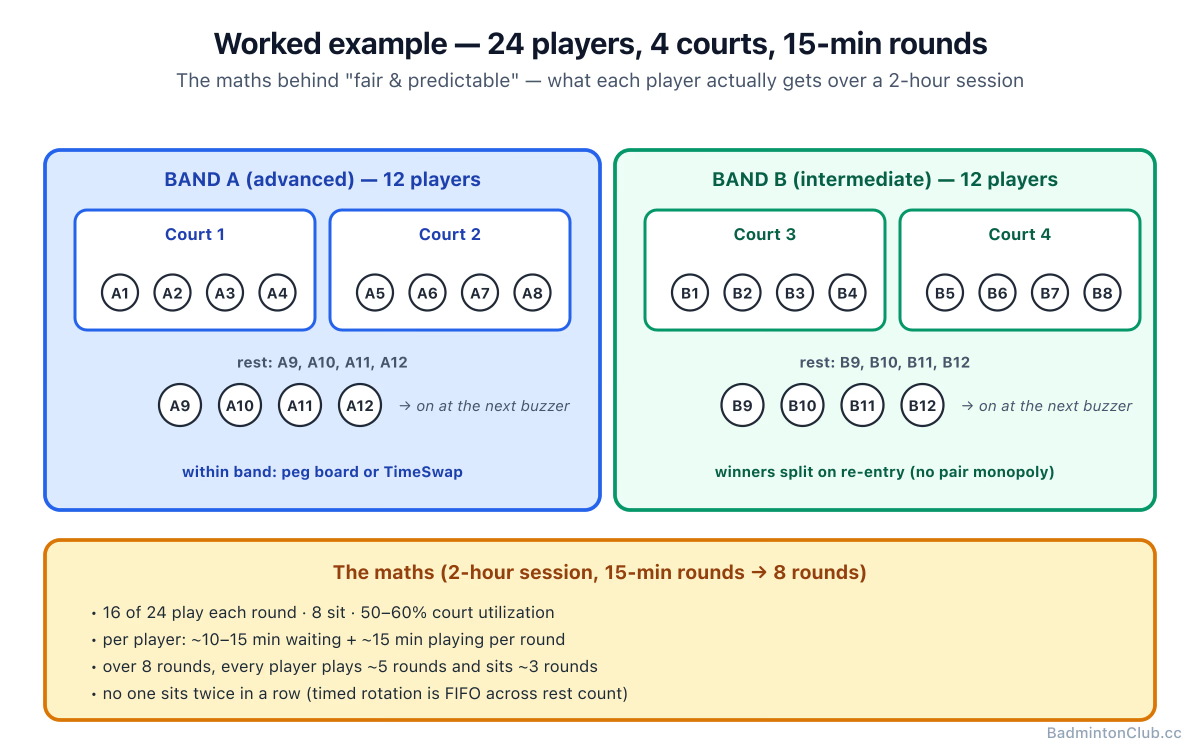
A second example that's worth seeing: 36 players on 6 courts is where the hybrid starts to really outperform any single system. Six courts means you can run a two-band split (Band A on courts 1-3, Band B on courts 4-6) with timed swaps and full rest fairness within each band. The maths: 36 players / 6 courts = 6 per court at peak, so 24 on, 12 off each round. Each player plays ~5 rounds in a 2-hour night and rests ~3 — same 50–60% utilization as the 24-player case, but the quality of games is markedly better because the bands keep skill roughly matched. The only thing that breaks this setup is the one rogue strong player who turns up having been away for six weeks and immediately gets auto-grouped into Band A — for those nights, the manual override is worth its weight in gold. For clubs that prefer a fully skill-tiered approach without the queue layer, the Badminton Box League & Tiered Rotation system is the closest alternative.
Where it's popular & estimated share
The emerging best-practice standard in UK, AUS and NZ clubs that moved away from pure winner-stays toward timed, skill-grouped rotation — increasingly delivered via apps.
FAQ
- Q: What rotation should a busy badminton club use? A hybrid: peg-board queue + timed 12–15-min games + A/B/C skill grouping + winner-splits — or an app (TimeSwap) that automates all four.
- Q: How do I run a club night with too many players for the courts? Cap game length on a timer, queue fairly, group by skill, and mix partners — exactly what a hybrid does.
- Q: What's the ideal players-per-court ratio? Aim for ~50–60% court utilization (e.g. 24 players / 4 courts with timed swaps).
- Q: Can one app do all of this? Yes — TimeSwap combines timed swaps, skill balance, rest fairness, and partner variety.
- Q: Is the hybrid hard to run manually? It's the most setup; an app removes the overhead.
- Q: Why have clubs moved away from winner-stays? Court-time fairness — strong players dominated; timed skill-grouped rotation spreads play evenly.
- Q: Can I run a hybrid with a peg board only on a TV screen? Yes — many clubs do. The screen sits by the door, the queue is the visible list, and the captain uses a tablet to "pick" the next game.
- Q: Does the hybrid work for 8 players on 2 courts? Honestly, no — that's two few for the queue to matter. Drop to TimeSwap or Peg Board in their simpler form.
- Q: What's the smallest club size the hybrid earns its keep? About 16 players on 3 courts. Below that, the overhead of running two systems exceeds the benefit.
The hybrid badminton rotation combines a fair queue, timed games, skill grouping, and winner-splits into one system that actually works for 20–40 players on 3–6 courts. Learn how to layer all four levers, see worked examples for 24- and 36-player nights, and understand why this blend has become the emerging best-practice standard in busy clubs.