Off-Court Badminton Conditioning Programme: A Weekly Training Plan for Club Players
7 June 2026 · Badminton Fans
A solid weekly off-court badminton programme for a working adult fits in roughly 3–4 short sessions a week — two strength + plyometric, one HIIT/conditioning, and one mobility/recovery — sitting alongside your normal court play (2–3 court sessions), with one full rest day, periodised so you back off in the days before competition. It's a little and often job, not a brutal grind.
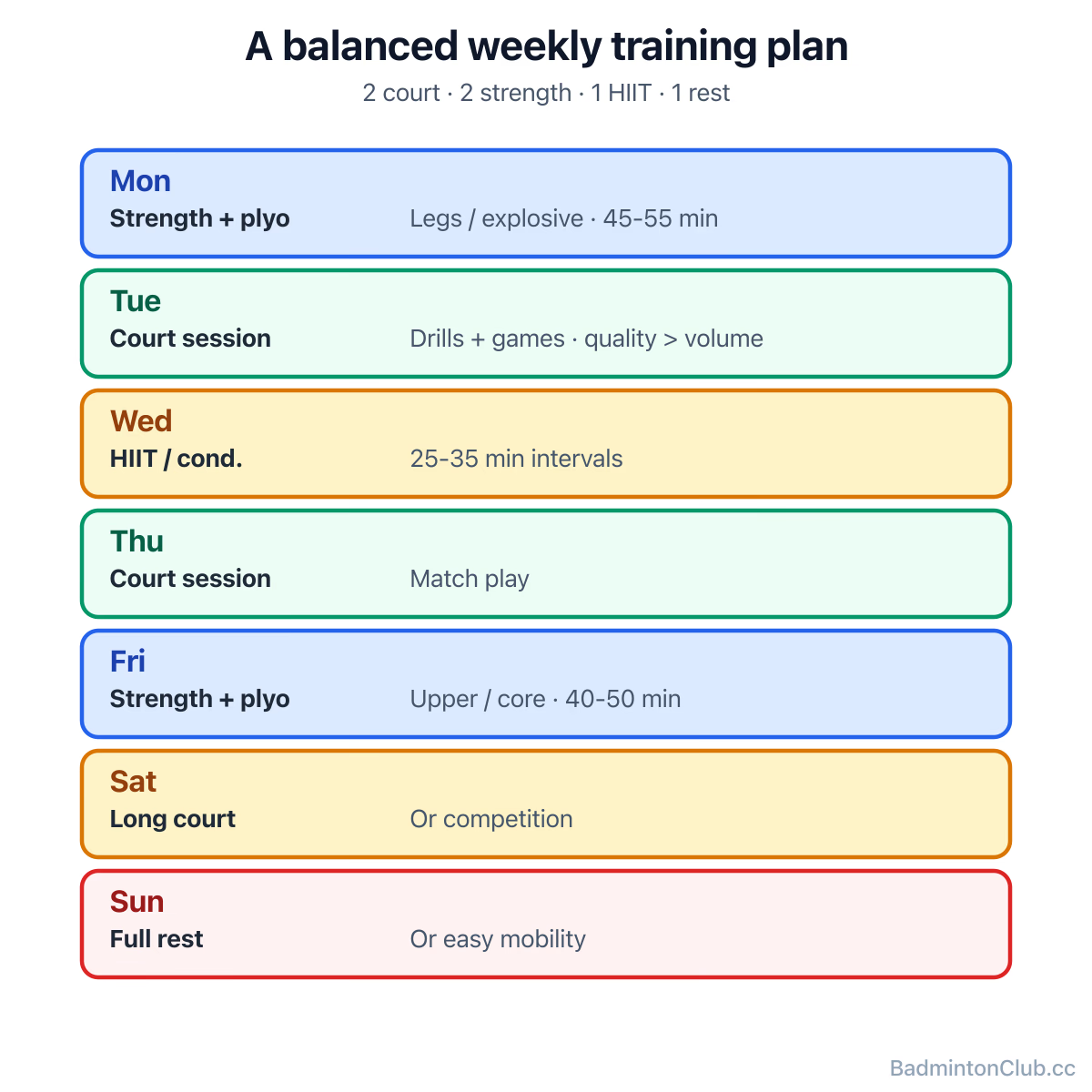
The core weekly template (6-day week, 1 rest)
A balanced week for a club player with 2–3 court sessions:
| Day | Session | Notes |
|---|---|---|
| Mon | Strength + plyo (legs/explosive) | 45–55 min. See Strength Training |
| Tue | Court session (drills + games) | Focus quality over volume |
| Wed | HIIT / conditioning | 25–35 min. See Stamina Training |
| Thu | Court session (match play) | |
| Fri | Strength + plyo (upper/core) | 40–50 min |
| Sat | Long court session or competition | |
| Sun | Rest or easy mobility | Non-negotiable |
This is the rhythm most adults can sustain. Two strength sessions, one conditioning, two-three court sessions, one rest day — every week. The cumulative effect over 8–12 weeks is large; the cost per day is moderate.
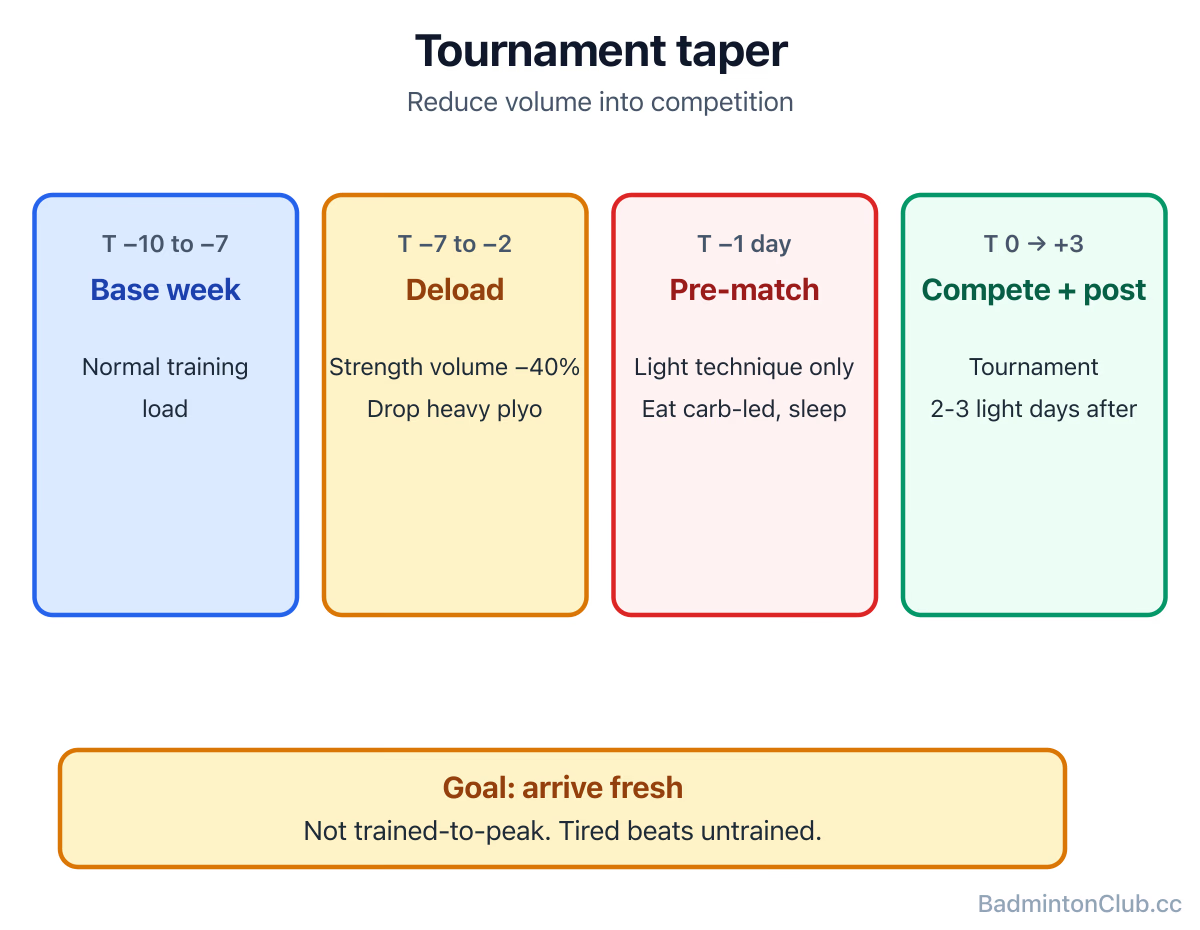
Periodisation — easing off before competition
You should deload in the 5–10 days before an important tournament — reduce strength volume by ~40%, drop heavy plyo, keep court technique work and light HIIT. The aim is to arrive fresh, not "trained to a peak". A tired player at a tournament loses to a slightly less-trained but fresh one every time.
After a tournament, take 2–3 lighter days before resuming hard training.
The minimal viable programme (2 days/week)
If 4 sessions a week is too much, two well-chosen sessions still move the needle:
- One full-body strength + plyo session (40–55 min, 2 main lifts + accessories + 2 jump variations + core).
- One HIIT/conditioning session (25–30 min, intervals).
Plus your normal court time. That's enough to materially improve durability, strength, and rally fitness for most club players. Two consistent sessions beats four planned-but-skipped.
Where to start (week 1–4)
- Week 1: half the recommended volume of everything. Get the technique on lifts and jumps right.
- Week 2: add one set per main exercise; keep loads conservative.
- Week 3–4: settle into the full programme.
- Week 5+: progressive overload — add a small load, an extra rep, or a set every 1–2 weeks.
Stop adding load when sleep, joints or court play start to suffer; the programme is the servant of your badminton, not the master.
What this looks like on a club night
Honestly? Most players do zero off-court conditioning and wonder why they plateau or break down. The ones who do even two short sessions a week visibly out-pace them within a few months — they last longer in games, recover faster between rallies, and pick up far fewer niggles. A blunt opinion: write a basic two-session week down, put it in your calendar like a meeting, and treat it like a meeting. That single act — making it scheduled — is the biggest predictor of whether off-court work actually happens. Programmes don't fail because they're wrong; they fail because they're optional. The simplest accountability trick I've seen actually work: stick the two-line plan onto the team page on BadmintonClub.cc where your doubles partner can see it. Skipping a session you've publicly declared to a partner is harder than skipping one only you know about.
FAQ
- Q: How many off-court training sessions do I need per week? 2–4 short sessions for most club players — two strength + plyo, one HIIT, and optionally one mobility session — alongside 2–3 court sessions and one full rest day.
- Q: What's the minimum off-court programme that still works? Two well-chosen sessions a week — one full-body strength + plyo and one HIIT — done consistently for 8–12 weeks.
- Q: How do I taper before a tournament? Cut strength volume by about 40% in the 5–10 days before, drop heavy plyometrics, keep light HIIT and technique work, and arrive fresh rather than trying to peak.
- Q: Can I train hard the day before a match? No — leave at least 24–48 hours between hard strength or HIIT and competition; technique work or a light knock-up is fine.
- Q: How long until I notice off-court training paying off? Most players feel meaningful change in 4–6 weeks of consistent twice-weekly training, with bigger gains over 2–3 months.
- Q: Should beginners do off-court conditioning? Yes, but start small — a single weekly strength session and a single HIIT session, focused on form and consistency, builds the habit and protects you from injury as your court hours grow.
Coaching notes (beyond the drills) — things no single article tells you
The articles above cover the individual pieces. This final section is the connective tissue — the things experienced coaches wish they'd been told at the start of their fitness journey, and that don't belong cleanly inside any single article. Use it as a "before you start, read this" page, or chop it into pieces to fold into the article where it best fits.
The 80/20 rule of adaptation
About 80% of the fitness gains a club player makes in any given year come from roughly 20% of the work — and that 20% is almost always the boring part: sleep, consistent easy aerobic base, two short strength sessions, and not skipping rest days. The flashy part (plyometrics, sprint work, smash-power programmes) gives the visible wins but only compounds on a base the boring part builds. Most players chase the flashy 80% and wonder why the gains flatten. Flip the ratio: get the boring 20% so right that the rest is almost a bonus.
A useful mental check: if your weekly training includes two strength sessions, one HIIT, two court sessions, daily mobility and a full rest day, and you're sleeping 7–8 hours most nights, you're already doing the 20% that matters. Don't add more — add consistency.
Year periodisation — the four cycles most club players miss
Elite athletes periodise the year into clear phases. Recreational players don't, then complain that "off-season" feelling slow and "pre-season" still feeling flat. A simple four-phase layout that fits a club calendar:
| Phase | Length | Focus | Intensity |
|---|---|---|---|
| Off-season (deep base) | 6–10 weeks | Strength, aerobic base, technique | Build, not peak — moderate load |
| Pre-season (sharpening) | 4–6 weeks | Plyometrics, court HIIT, smash volume | Progressively higher intensity, lower volume |
| In-season (maintain) | 10–16 weeks | 1 strength + 1 mobility + matches | Maintain, don't build — recover between sessions |
| Tournament peak (taper) | 7–10 days | Light technique + deload | ~40% of normal strength volume, no heavy plyo |
The honest line: most club players never leave the "off-season" phase — they do moderate-intensity work year-round, never peak, never rest properly, and wonder why the December tournament performance matches the March one. A two-month off-season block (October–November for a spring league) followed by an in-season that genuinely backs off strength is the single biggest performance lever for working adults.
The "honeymoon plateau" (weeks 6–10) and how to break it
Almost every new training programme produces rapid visible gains for the first 4–6 weeks — better cardio, sharper feet, heavier smashes. Then progress stalls for 2–4 weeks, often right when motivation is highest. This is the honeymoon plateau: the body's initial neural adaptations have run their course and the slower structural adaptations (muscle, tendon, capillarisation) haven't caught up. Players who panic at this point add volume, get sore, lose form, and quit.
The fix is counterintuitive: do less, not more for 5–10 days. A deload week — same exercises, ~50% of normal volume, full rest days, focus on sleep and food — almost always restarts the gain curve. Strength coaches call this "supercompensation." The first plateau you push through this way is the moment you start to understand training.
Sleep is the actual recovery tool (and the numbers are stark)
Strength adaptations, glycogen replenishment, tendon repair and motor-skill consolidation all happen during sleep, not during training. The published figures: sleep extension studies show athletes who get 9+ hours perform measurably better on reaction time and decision-making than those getting 7. Most club players sleep 6–7 hours on work nights, then try to "make it up" with weekend lie-ins — which doesn't fully work because the circadian disruption cancels the benefit.
Two specific levers that move the needle without heroic changes:
- A 30-minute earlier bedtime, every night, for 4 weeks. Most adults can absorb this without lifestyle pain; the cumulative sleep gain is 14 hours/week. Noticeable on court within a month.
- A consistent wake time, weekends included. Sleep quality improves more from a fixed wake time than from a fixed bedtime, because it stabilises the circadian rhythm.
RPE — the free tracking tool most players ignore
Rate of Perceived Exertion (RPE) is a 1–10 scale you assign to each session after the fact — 1 = barely moving, 5 = steady working, 7 = hard, 9 = could not sustain, 10 = all-out sprint. It costs nothing, takes 10 seconds, and reveals patterns your memory smooths over.
A practical use: log RPE for each session for a month. You'll see:
- Court sessions you've been treating as "moderate" are actually 8s.
- Strength days you've been calling "hard" are 6s.
- Specific weeks where RPE climbs for 4–5 consecutive days — the overreaching pattern that precedes the niggle that ends your season.
The 7-day rolling average RPE is the cheapest overtraining alarm bell a club player has.
Common plyometric mistakes that cause the injuries plyometrics are supposed to prevent
Plyometrics are the most-misprogrammed element of badminton fitness. The three patterns I see most often:
- Cold jumps. Box jumps and depth jumps on a body that hasn't been warm for at least 10 minutes. The joint capsule, the Achilles, and the patellar tendon all need temperature to absorb landings; cold jumps are a recipe for an Achilles strain or a bruised heel. Always ramp up first: 3–5 minutes skipping, leg swings, then progress from low hops to higher jumps.
- Too much volume. Beginners copy pro programmes and do 50+ jumps per session. Even 30 box jumps on tired legs starts to degrade landing mechanics — and the form breakdown is the injury. Cap at 25–40 total jumps for most sessions; quality > quantity.
- Landings that leak. A box jump absorbed on a straight, locked leg is a shin-bone shock; the same jump absorbed on a soft knee, hips back, glutes engaged, is a strength exercise. Watch yourself in a mirror or film one set — the difference is night and day.
If you fix nothing else, fix the landing.
Age-related adjustments most articles skip
Recovery time roughly doubles between age 25 and 45 for the same training load — a hard HIIT session you bounced back from on Tuesday at 28 takes 48 hours to recover from at 42, not 24. The training plan that worked at 30 produces niggles at 40. Honest adjustments for the over-35 club player:
- Drop plyometric volume by ~25–30% from what the article recommends. The gains come from quality jumps, not from more of them.
- Add an extra rest day between hard strength and HIIT sessions.
- Increase warm-up length by 2–3 minutes — older joints need more time to lubricate.
- Prioritise tendon-friendly exercises (calf raises with slow eccentrics, slow Bulgarian split squats) over ballistic variations.
- Don't play through "deep" stiffness. Surface tightness eases with warm-up; deep joint stiffness that doesn't shift in 15 minutes is a tendon asking for rest.
This is not "old = weak" — it's "old = recover slower." Adjust the calendar, not the ambition.
The unspoken rule: the warm-up is part of the session
A common pattern at club nights: arrive, kit up, do 2 minutes of half-hearted arm circles, start playing. The "warm-up" the articles describe is treated as optional. It isn't — and the cost shows up in the injury statistics rather than the immediate session. Specifically:
- First-game smash output is ~10–15% lower when you haven't warmed up. The muscles are cool, the nervous system is at rest, the swing speed isn't there. You feel slow and "off" without realising why.
- Injury risk in the first 20 minutes of a session is the highest of the night. Rolled ankles, tweaked calves, "I don't know what I did to my shoulder." Almost all of these are warm-up failures.
Make the 10-minute dynamic warm-up the first 10 minutes of the session, not the last 5 minutes before you start.
The "10% rule" for load progression
When adding load to a strength programme or volume to a plyometric session, increase by no more than 10% per week. This is the rule that lets tendons, joints and connective tissue keep up with muscle adaptation — they adapt slower than muscle does, and the gap is where most overuse injuries start.
If you can squat 80 kg for 5 reps this week, the target next week is no more than 88 kg. If you're doing 30 box jumps per session this week, the target next week is no more than 33. The progress feels painfully slow, and that's the point — it's the speed at which connective tissue can adapt safely.
A pre-tournament check (the week before, not the day before)
The day before a tournament is too late to do anything except rest. The week before is when you actually prepare. A simple 7-day pre-event checklist:
- 5–6 days out: Last moderate training session. Strength at 60% of normal volume, easy 20-minute aerobic, light court technique. Finish tired, not exhausted.
- 4–3 days out: Light skill work. Shadow footwork, gentle knock-up, a few sets of footwork drills. No strength, no plyo.
- 2 days out: 20-minute easy court session or 15-minute mobility. That's it.
- 1 day out: Off. Walk, eat well, hydrate, sleep early.
- Event day: The warm-up is the only "training" you do. Walk on court fresh.
The opposite — training hard the day before, then playing tired on day one — is the most common tournament mistake at amateur level. The taper above is roughly the same protocol elite athletes use; the difference is that amateurs usually skip it.
What I wish every player told themselves on day one
If you only remember one thing from this series, make it this: the training you can keep doing for years beats the programme you'll abandon in three weeks. The club player who jogs twice a week, lifts twice a week, plays twice a week, sleeps 7+ hours, and warms up properly for ten minutes is, after a year, in a different league from the player who did an "intense 4-week shred" and then went back to nothing. Adaptations are slow. Habits are faster. Build the habit, the adaptation looks after itself.
Sources & verification
Fitness content is written fresh from coaching and sports-science consensus. The specific figures cited in the series are verified against the following:
- Calorie burn (~475–525 kcal/hr social, ~500–675 kcal/hr competitive; MET 5.5 social, ~7.0 competitive): Fitness Volt — "Calories Burned Playing Badminton Calculator"; Captain Calculator — "Calories Burned Badminton Calculator"; Tap.health — "How Many Calories Are Burned in 1 Hour of Badminton". Singles burns more than doubles because court coverage is greater.
- Rally physiology / work-to-rest pattern (5–15 second high-intensity bursts): widely reported in sports-science literature on badminton; the training implication (HIIT > steady-state for rally fitness) follows directly from this profile.
- Injury patterns (ankle, knee, shoulder, elbow as the most common): consistent with sports-medicine consensus on racket-sport injuries; this article gives general prevention guidance, not medical advice, and recommends a physio for any persistent pain.
All other content reflects established coaching consensus on programming, plyometrics, strength, mobility and nutrition — written in original wording and structure for this series. Before publishing, do the human pass described at the top of this file: drop one real thing from your own world into each article (a local sports physio's name, a photo of your club's gym, your own typical week). That's the dependable finish.
An off-court badminton conditioning programme for working adults: two strength + plyo sessions, one HIIT, one mobility, sitting alongside two or three court sessions, with one full rest day a week. Includes periodisation around tournaments (deload 5–10 days, then 2–3 light days after), a minimum-viable two-session-per-week version, and a phased ramp from week 1 to week 5+. The honest line: programmes fail because they're optional, not because they're wrong.